


AutoSEO makes a very attractive promise.
For £115 per month, it says it can handle a huge chunk of your SEO workload automatically.
That includes:
- 30 SEO-optimised articles every month
- Search-term research
- Competitor analysis
- Auto-publishing
- Custom images and infographics
- Backlink building
- AI search visibility
- Ongoing SEO automation
The sales page goes further.
AutoSEO currently values that package at $6,200 per month.
You pay £115.
It also uses messaging suggesting the price will increase to £175 soon.
On paper, that sounds incredible.
If one tool can genuinely replace thousands of dollars of SEO work for £115 per month, it deserves attention.
But that is a very big claim.
And after looking at how AutoSEO works, what users are saying, and the type of work it automates, I think the reality is more nuanced.
AutoSEO appears to be a real and potentially useful automation platform.
- It can save time.
- It can produce decent content.
- It can help businesses publish more consistently.
But I would not describe it as hands-off SEO.
And I would be particularly cautious about recommending it to beginner bloggers.
Because if you do not already understand SEO, content quality and backlink risk, you may not know when the automation gets something wrong.
That matters.
Transparency Note
I am not an affiliate for AutoSEO and I do not earn a commission if you sign up.
This is a research-based review looking at AutoSEO’s current pricing, features, marketing claims, user feedback, backlinks, content quality and whether it makes sense for beginner bloggers and busy parents.
Where I recommend alternatives later in the review, I will clearly disclose any affiliate relationship.
Quick Verdict
AutoSEO looks like a useful automation tool for experienced site owners, but I would not recommend it to a new blogger.
The platform can automate keyword research, content creation, publishing, images and parts of link building.
That can save time.
But you still need to review the articles, check accuracy, watch for keyword cannibalisation, assess backlink quality and make sure the strategy actually makes sense for your site.
That is where I think the “SEO on autopilot” marketing goes too far.
I am also not convinced by the claim that the £115 monthly package provides $6,200 worth of SEO value.
The product may still be worth £115 for the right user.
That is very different from saying it replaces $6,200 of professional SEO work every month.
My Rating for Experienced Users: 3.8/5
My Rating for Beginner Bloggers: 2.5/5
Product: AutoSEO
Website: getautoseo.com
Focus: Automated SEO, AI content, research, publishing and backlinks
Current UK Price: £115 per month
Promotional Claim: $6,200 monthly value
Price Warning: Promotional messaging currently suggests the price may increase to £175 per month
Best For: Experienced site owners who understand SEO and can supervise automation
Beginner-Friendly? Easy to use does not mean low risk for beginners
Affiliate Link: No
Recommended? With caution, for experienced users
Before You Buy Another AI Tool…
Done-for-you tools can save time, but they work best when you already know what you are building.
My free Parent Blogging Starter Kit helps you get the foundations in place first, including your niche, content ideas, weekly plan, income goals and realistic blogging roadmap.
Start with the strategy. Then decide which tools are actually worth paying for.
Get the Free Parent Blogging Starter KitFree resources for busy parents who want to build online income without chasing every new shortcut.
What Is AutoSEO?
AutoSEO is an AI-powered SEO automation platform.
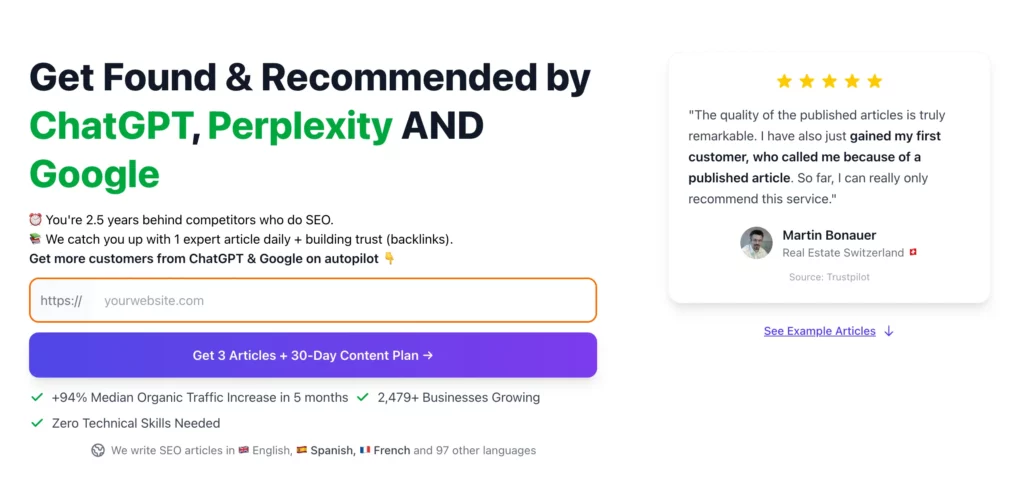
Its main promise is to take over much of the repetitive work involved in running an SEO content strategy.
Instead of manually researching keywords, creating content briefs, writing articles, designing graphics, publishing posts and building links, AutoSEO attempts to automate much of that process.
The platform currently promotes a monthly package containing:
- 30 SEO-optimised articles
- Search-term research
- Competitor analysis
- Auto-publishing
- Custom images
- Infographics
- Backlink building
- AI search visibility support
That is a substantial amount of activity.
And that is exactly why the product is attractive.
A small business or blogger may look at that list and think:
“Why would I pay an agency thousands every month when software can do all of this for £115?”
That is the comparison AutoSEO itself encourages.
But automation and professional SEO are not always equivalent.
The software can create the work.
You still need to know whether the work is good.
That distinction sits at the heart of this review.
What Does AutoSEO Promise?
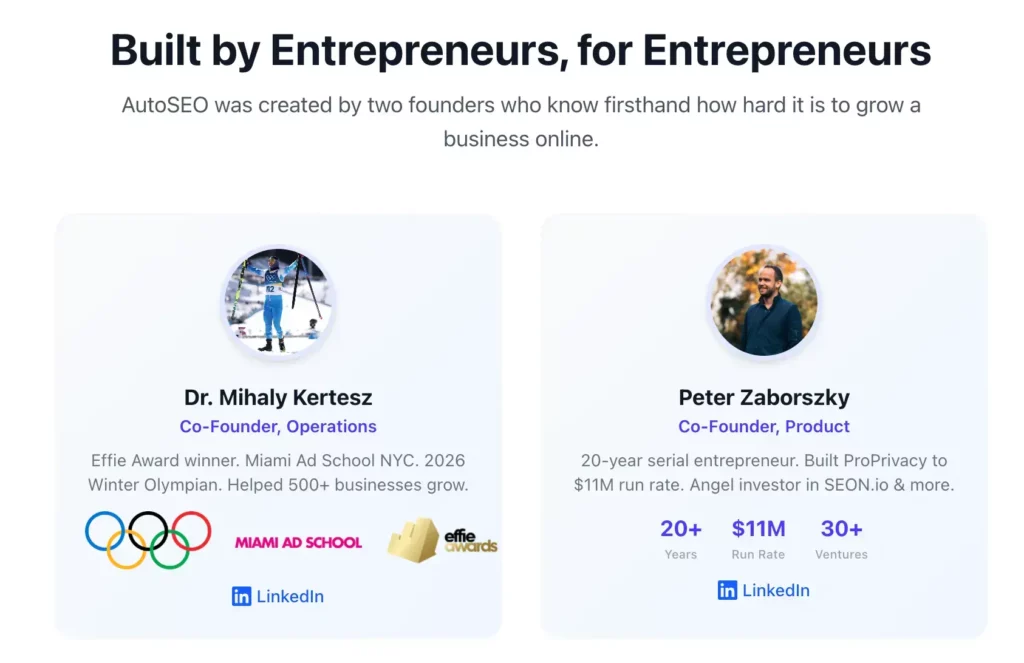
AutoSEO’s marketing is quite aggressive.
The platform talks about SEO being handled on autopilot.
It promotes the idea that businesses can effectively wake up to new content and new SEO work being completed automatically.
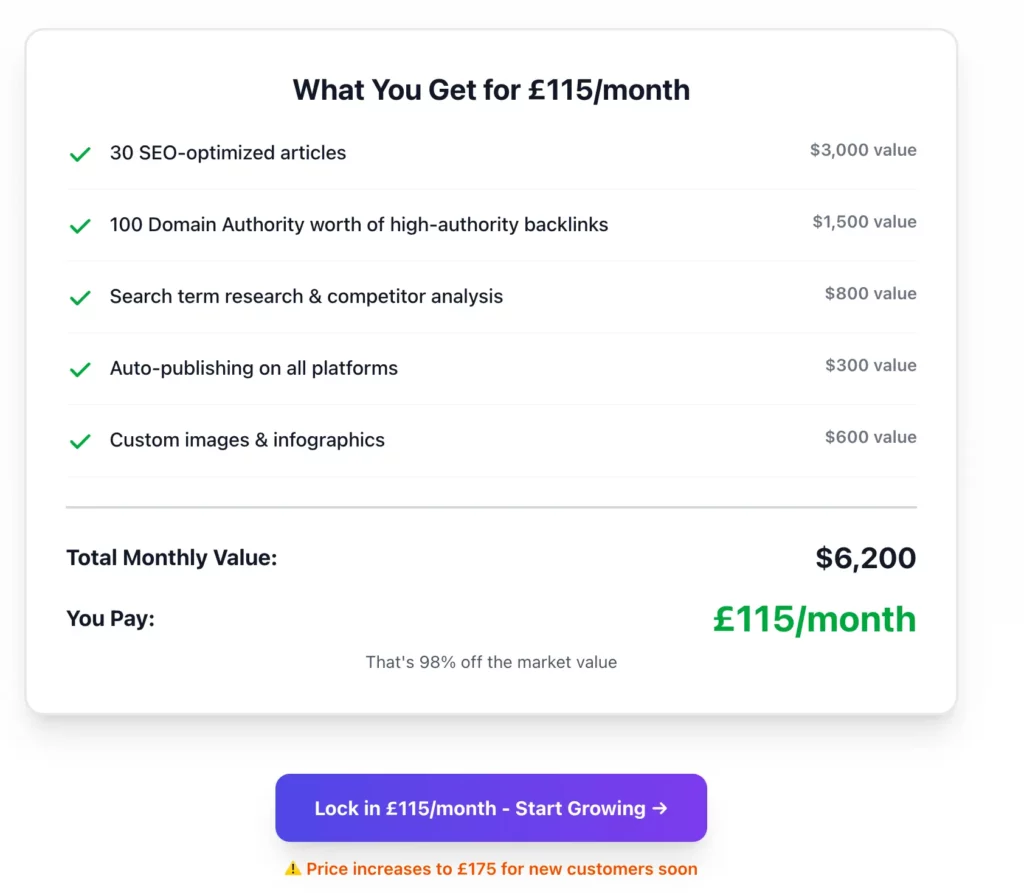
The checkout page currently values the monthly package like this:
- 30 SEO-optimised articles: $3,000 value
- 100 Domain Authority worth of backlinks: $1,500 value
- Search-term research and competitor analysis: $800 value
- Auto-publishing: $300 value
- Custom images and infographics: $600 value
Total monthly value:
$6,200.
Price:
£115 per month.
That is an enormous difference.
The maths is easy.
The assumptions behind the valuation deserve more attention.
Is AutoSEO Really Giving You $6,200 of Value?
This is one of the first claims I would challenge.
Not because AutoSEO has no value.
It clearly does.
The problem is comparing automated output directly with professional services.
30 Articles = $3,000
Thirty professionally researched, written and edited SEO articles could easily cost $3,000.
They could cost considerably more.
But thirty automatically generated articles are not automatically equivalent to thirty $100 professional articles.
That depends on quality.
If you still need to:
- Fact-check the content
- Correct technical mistakes
- Add personal experience
- Improve the writing
- Check links
- Fix repetition
- Review search intent
- Avoid keyword cannibalisation
Then AutoSEO has saved part of the workflow.
It has not necessarily replaced the whole $3,000 service.
That can still be valuable.
But it is a different value proposition.
Backlinks = $1,500
This is the claim I am most uncomfortable with.
AutoSEO currently describes the package as including:
“100 Domain Authority worth of high-authority backlinks.”
I do not think that is a useful way to value backlinks.
Domain Authority is a third-party metric created by Moz.
It is not a Google ranking score.
And you cannot simply add DA values together and assume the total represents backlink quality.
A relevant link from a trusted website with real traffic can be valuable.
A weak directory link from an unrelated site may add very little.
What matters includes:
- Relevance
- Editorial quality
- Real traffic
- Placement
- Indexing
- Site quality
- Context
- Whether the link looks natural
So I would not accept a $1,500 backlink value purely because the links supposedly add up to 100 DA.
We need to look much more closely at what users are actually receiving.
Research and Competitor Analysis = $800
Research can absolutely be valuable.
A skilled SEO professional may spend hours understanding a niche, evaluating competitors and finding opportunities.
But automation changes the economics.
An AI platform carrying out that work at scale is not necessarily delivering $800 of bespoke expert analysis every month.
Again, that does not make it worthless.
It means the headline valuation should be treated as marketing rather than an independent measure of value.
Auto-Publishing = $300
Auto-publishing is convenient.
It saves repetitive admin.
But $300 per month feels like a generous valuation unless the publishing workflow is replacing substantial manual work across several sites.
For one blogger, this feature may save minutes rather than hundreds of dollars.
Images and Infographics = $600
Custom design can be expensive.
Thirty sets of professionally designed visuals could easily reach $600.
But automatically generated images are not the same product.
The value depends on whether the graphics are actually good enough to publish without editing.
If they are, great.
If you still need to redesign them, the real saving is lower.
My Take on the $6,200 Claim
I would separate two questions.
Is AutoSEO worth £115 per month?
Possibly.
Is AutoSEO automatically replacing $6,200 of professional SEO work every month?
I am much less convinced.
That claim makes the product sound more dramatic than I think the comparison really supports.
The £115 subscription should stand or fall on whether it saves you enough time and produces enough useful work.
It does not need a $6,200 headline to make the case.
AutoSEO Pricing in 2026
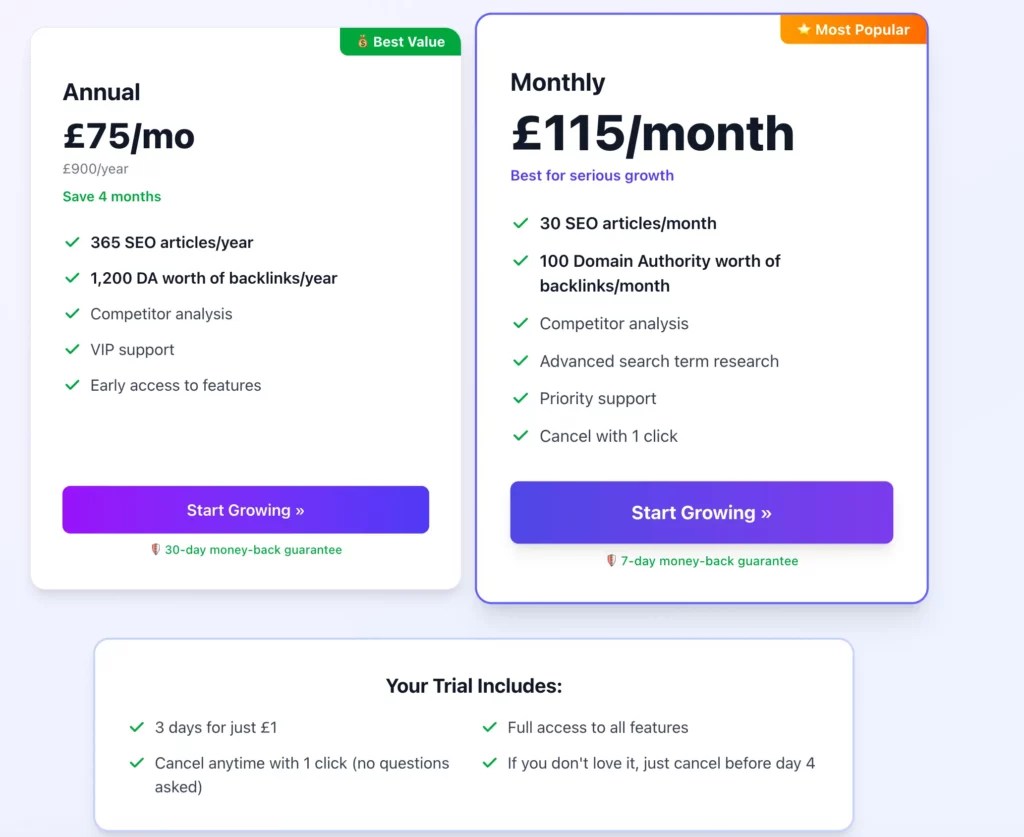
The current UK checkout price I found is:
£115 per month.
That works out at:
£1,380 per year.
There is also time-sensitive messaging suggesting that the monthly price may increase to £175.
If that happens, the annual cost would increase to:
£2,100 per year.
That is a significant difference.
At £115 per month, I can see a reasonable value argument for an established business using the automation heavily.
At £175 per month, I would expect the content quality, backlink quality and time savings to be much more consistently strong.
I would also be cautious about urgency messaging.
The price may genuinely be increasing.
But whenever a sales page uses a “price going up soon” message, I would avoid rushing into the purchase.
Buy because the tool fits your business.
Not because a timer or warning makes you nervous about missing the current price.
Does AutoSEO Actually Work?
This is where things get interesting.
The independent feedback is mixed, but not uniformly negative.
There are users who genuinely like AutoSEO.
Positive reviewers often mention:
- Time savings
- Easy publishing
- Decent article quality
- Useful automation
- A simpler content workflow
- Good results after detailed setup
That tells me there is a real product underneath the marketing.
This is not something I would dismiss as useless software.
But the negative feedback repeatedly highlights the areas where automation needs human oversight.
And those are exactly the areas that matter most to beginner bloggers.
Quick Note: I’m John Crossley, founder of Flex For Families. I review online business opportunities through the lens of family life, focusing on costs, time commitments, risks, and whether they genuinely help parents create more flexibility.
What Do AutoSEO Users Say?
AutoSEO currently has a generally positive Trustpilot rating, but the distribution is worth looking at rather than simply quoting the average.
There are many five-star reviews.
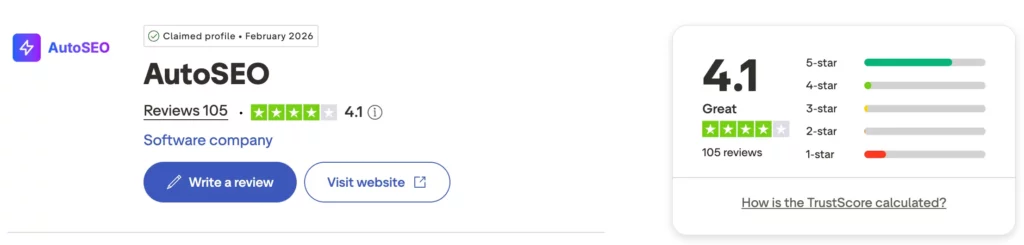
There is also a meaningful group of one-star reviews.
That usually tells me the experience depends heavily on expectations, setup and how closely the user supervises the system.
Positive users often say AutoSEO saves time and produces usable content.
Some still mention making edits.
That is an important detail.
Even happy users are not always describing a completely hands-off system.
Negative reviewers raise concerns around:
- Article repetition
- Indexing
- Content quality
- Outbound links
- Backlink relevance
- Support
- Cancellation
- Lack of ranking movement
I would not treat every negative review as proof that the platform has a systemic problem.
But repeated patterns deserve attention.
And there are several patterns here that matter for bloggers.
What Is the Article Quality Like?
This is probably the first thing most bloggers will care about.
AutoSEO can publish 30 SEO-optimised articles per month.
That sounds impressive.
But volume only helps if the articles are good enough to deserve a place on your site.
From the feedback I found, the quality appears mixed.
Some users say the drafts are surprisingly strong.
They report getting usable structure, sensible topic coverage and content that only needs light editing.
Others say the articles become repetitive, feel generic or need significant rewriting before they are ready to publish.
That difference matters.
AI content quality often depends heavily on:
- The information you give the system
- How well it understands your business
- The niche
- How technical the subject is
- How much first-hand experience the article needs
- How carefully you review the output
A simple informational topic may work reasonably well.
A highly technical article is a different challenge.
Good Structure Is Not the Same as Good Content
AI is generally quite good at creating structure.
- Headings.
- Lists.
- FAQs.
- Introductions.
- Summaries.
That can make an article look polished very quickly.
But a well-structured article can still be inaccurate, shallow or generic.
For me, the more important questions are:
- Does it say anything useful?
- Is it factually correct?
- Does it understand the reader?
- Does it add anything competitors have missed?
- Would I be comfortable putting my name on it?
Those are much harder tests.
Where Human Experience Still Matters
This is particularly important for bloggers.
Your own experience is often the part AI cannot reproduce.
That might include:
- A product you genuinely tested
- A mistake you made
- Screenshots
- Personal results
- Costs you actually paid
- A process you use
- Something that did not work
- Advice specific to your audience
If AutoSEO gives you the foundation and you add those things, it could save considerable time.
If you publish the draft exactly as generated, I think the risk of generic content increases significantly.
Is AutoSEO Really Autopilot?
Not in the way I would use the word.
AutoSEO can automate a lot.
- It can research topics.
- Generate content.
- Create graphics.
- Publish articles.
- Build links.
That is genuine automation.
But I would not set it running and stop checking the site.
You still need to monitor:
- Accuracy
- Content quality
- Internal links
- External links
- Keywords
- Search intent
- Cannibalisation
- Site structure
- Backlinks
- Performance
That is not completely hands-off.
Automation vs Autopilot
I think there is an important difference.
Automation means software performs repetitive tasks for you.
Autopilot suggests you can largely stop thinking about those tasks.
I am comfortable calling AutoSEO automated.
I am much less comfortable calling good SEO autopilot.
SEO involves judgement.
You have to decide what deserves publishing.
- Which opportunity matters.
- Whether an article is accurate.
- Whether two pages are competing.
- Whether a backlink is useful.
- Whether a recommendation fits your wider strategy.
Software can assist with those decisions.
I would not hand them over completely.
Positive Reviews Say Something Similar
Interestingly, even some positive users make this point.
They like the platform.
They say it saves time.
But they also mention reviewing or tweaking the output.
That is not necessarily a criticism.
I use AI in a similar way.
The problem is when marketing encourages a beginner to believe the checking stage is optional.
I do not think it is.
What About AutoSEO’s Backlinks?
This is probably the biggest concern I have with the product.
AutoSEO includes backlink building as part of the subscription.
The current offer describes this as:
“100 Domain Authority worth of high-authority backlinks.”
As I mentioned earlier, I do not think adding Domain Authority scores together tells you much about backlink quality.
A backlink is not valuable simply because a third-party metric is high.
What Makes a Good Backlink?
I would care much more about:
- Is the website relevant to my niche?
- Does it have real users?
- Does the page containing the link make sense?
- Is the link editorial?
- Is the page indexed?
- Does the site publish genuine content?
- Would I still want the link if Google did not exist?
Those are much better questions.
What Are Users Reporting?
Some user feedback has raised concerns about backlink relevance and quality.
There are reviewers who say the links they received did not look particularly valuable.
Others have mentioned directory-style placements.
That does not prove every backlink AutoSEO creates is poor.
But it is enough to make me cautious.
If you are paying partly because the package promises backlink building, I would inspect those links rather than assuming they are helping.
Why This Matters More for Beginners
An experienced SEO can look at a backlink and make a reasonable judgement.
A new blogger may simply see:
DA 40.
Great.
That is risky.
Metrics can look impressive while hiding poor relevance or questionable placement.
If you do not understand backlinks yet, automation does not remove that knowledge gap.
It can actually make it easier to create problems faster.
Could AutoSEO Cause Keyword Cannibalisation?
Potentially.
Keyword cannibalisation happens when multiple pages on your site compete for very similar search intent.
Imagine you already have:
“Best Blogging Platforms for Beginners”
Then an automated system publishes:
“Best Blogging Platforms for New Bloggers”
Then:
“Top Blogging Platforms for Beginners”
Then:
“Which Blogging Platform Should a Beginner Choose?”
Those may be four useful articles.
Or they may be four versions of essentially the same page.
That depends on search intent.
Why 30 Articles a Month Makes This More Important
Thirty articles every month is a lot.
That is 360 articles per year.
At that pace, content planning needs to be very good.
Otherwise, you can quickly create:
- Overlapping articles
- Weak supporting pages
- Duplicate search intent
- Bloated categories
- Internal linking confusion
Publishing more is not automatically better.
I would rather publish 60 genuinely useful, well-planned articles than 360 pages that compete with each other.
Independent Users Have Raised This Concern
One hands-on review specifically raised concerns about topic overlap and potential cannibalisation.
That makes sense to me.
The faster you automate publishing, the more important the underlying content strategy becomes.
If AutoSEO understands your existing content properly and avoids overlap, great.
I would still check.
What Does Trustpilot Say About AutoSEO?
The Trustpilot picture is fairly interesting.
AutoSEO has a generally positive overall rating.
Most reviews are five-star.
There is also a noticeable group of one-star reviews.
That tells us more than the headline score alone.
What Positive Reviewers Like
Common positive themes include:
- Significant time savings
- Easy setup
- Convenient publishing
- Good content structure
- Useful automation
- Supportive customer service
- Decent results after good configuration
Some reviewers use the platform across several websites.
That is where I think AutoSEO starts making more sense.
If you already understand SEO and manage multiple sites, automation can remove a lot of repetitive work.
What Negative Reviewers Mention
The negative feedback includes concerns around:
- Repetitive articles
- Content needing substantial editing
- Poor indexing
- Questionable backlinks
- Unrelated outbound links
- Cancellation problems
- Unexpected charges
- Limited ranking improvement
I would be careful with these claims.
Individual Trustpilot reviews are individual experiences.
They are not proof that every customer will encounter the same issue.
But when similar concerns appear repeatedly, they are worth investigating.
Cancellation and Billing
There are several complaints around trials, cancellations and payments.
AutoSEO says cancelling is straightforward.
Some reviewers say their experience was different.
I cannot tell you which side represents the typical customer.
My practical advice would be:
If you take the trial, note the exact renewal date.
Take a screenshot of the offer.
Check the price you will move onto.
And if you cancel, keep confirmation.
That is sensible whenever a trial converts into a relatively expensive monthly subscription.
What Do Independent Reviews Say?
I found two hands-on reviews particularly useful because they went beyond simply repeating the AutoSEO sales page.
One 90-Day Test
One reviewer tested AutoSEO for around 90 days.
They liked the automation and said a reasonable proportion of the articles were usable drafts.
But they also reported:
- Limited keyword movement
- Repetitive content
- Shallow coverage in some areas
- The need for regular human oversight
Their overall conclusion was that AutoSEO worked better as a content assistant than as a complete SEO replacement.
That sounds believable to me.
And it is probably a much healthier expectation than “SEO runs itself.”
A Specialist Business Test
Another reviewer used AutoSEO on a specialist business website.
They liked parts of the content workflow and topic generation.
But they raised concerns around:
- Technical accuracy
- Publishing volume
- Keyword overlap
- Tag and index bloat
- Backlink quality
That test interests me because specialist content is where AI oversight matters most.
If a tool writes something confidently but incorrectly, a beginner may never notice.
An expert in the subject probably will.
Is AutoSEO Safer for Experienced SEOs Than Beginners?
I think it probably is.
That sounds strange because automation products are often marketed as making complicated tasks easier for beginners.
But experienced users have one major advantage.
They know when the automation is wrong.
An Experienced User Can Spot Problems
Someone who already understands SEO is more likely to notice:
- Poor search intent
- Weak keyword choices
- Cannibalisation
- Bad internal linking
- Thin content
- Questionable backlinks
- Over-optimisation
- Technical mistakes
They can use AutoSEO to speed up the work while keeping control of the strategy.
That is a sensible use of AI.
A Beginner May Trust the Output Too Much
A new blogger sees:
- SEO optimised.
- High-authority backlink.
- Competitor research.
- AI visibility.
Those labels sound reassuring.
But the beginner may not have enough experience to challenge them.
That creates a risk.
The product can make them more productive before they have learned what good work looks like.
And faster production of poor decisions is not really progress.
Why This Matters for Busy Parent Bloggers
The promise is particularly tempting if you are short on time.
Thirty articles per month without writing them yourself?
That sounds ideal.
But I would ask a different question.
How long will it take you to check 30 articles?
If every article takes 20 minutes to review properly, that is 10 hours of quality control each month.
If some need heavier editing, it could be considerably more.
Then add:
- Backlink checks
- Analytics
- Site maintenance
- Internal linking
- Updating old content
- Your actual business tasks
Suddenly the “hands-off” system looks less hands-off.
AutoSEO could still save time.
But I would treat it as a productivity tool, not a replacement for judgement.
Who Is AutoSEO Best For?
I think AutoSEO makes the most sense for people who already understand SEO.
That may sound slightly backwards for an automation platform.
But experience makes automation safer.
Experienced Site Owners
If you have been running websites for several years, you probably already know what good content looks like.
- You can spot weak topic choices.
- You understand internal linking.
- You know when two articles overlap.
- You can look at a backlink and question whether it is actually valuable.
That makes it much easier to use AutoSEO as a productivity tool.
Let the software handle more of the repetitive work.
Keep yourself responsible for the strategy.
That feels like the strongest use case.
SEO Professionals
Someone managing several websites may get considerably more value from AutoSEO than a solo beginner.
Thirty articles per month becomes easier to justify when you have several sites requiring content.
Automated research and publishing can also remove repetitive admin.
An experienced SEO professional can then review the output rather than creating everything manually.
Small Businesses That Already Have SEO Knowledge
A business owner with an established website and someone capable of supervising SEO could also benefit.
The platform may reduce reliance on freelancers for routine content production.
Again, I would still want someone checking what gets published.
Anyone Who Values Time More Than the £115 Subscription
This is ultimately the value calculation.
If AutoSEO saves you ten hours every month and those ten hours are worth considerably more than £115 to you, the subscription can make sense.
That is a much better reason to buy than the “$6,200 value” claim.
Who Should Avoid AutoSEO?
There are several groups I would steer away from it.
Brand-New Bloggers
This is the biggest one.
If you are still learning:
- Keyword research
- Search intent
- Content quality
- Internal linking
- Basic SEO
- Backlinks
- Site structure
I would learn those things before automating them.
You need enough knowledge to recognise when the system gets something wrong.
Bloggers on a Tight Budget
£115 per month is a significant ongoing expense.
That is £1,380 over a year at the current price.
If your blog has not made money yet, I would struggle to justify spending that much on one automation platform.
There are much cheaper ways to learn SEO and use AI.
Anyone Looking for Completely Passive SEO
I would not buy AutoSEO because you want to stop thinking about SEO.
You still need oversight.
If that sounds disappointing, this probably is not the product you are looking for.
Bloggers in Highly Technical or Sensitive Niches
The more important factual accuracy becomes, the more closely I would supervise AI-generated content.
That includes areas such as:
- Finance
- Health
- Legal topics
- Technical industries
- Safety
- Professional advice
I would be extremely cautious about automatically publishing content in those areas without expert review.
Anyone Buying Mainly for the Backlinks
I would not subscribe purely because the offer includes “100 Domain Authority worth” of backlinks.
I would want much stronger evidence around relevance and quality before assigning significant value to that part of the package.
Busy-Parent Decision Summary
If you are building a blog around work and family life, I would keep this decision simple.
If You Are a Beginner
I would skip AutoSEO.
£115 per month is a lot to pay for an automated system when you are still learning how to judge the output.
Learn the fundamentals first.
Use AI to help you.
Do not hand your entire content and SEO strategy over to it.
If You Already Understand SEO
AutoSEO becomes more interesting.
If you know how to review:
- Search intent
- Article quality
- Keywords
- Internal links
- Backlinks
- Site structure
Then the automation could genuinely save you time.
If You Only Have a Few Hours Each Week
Do not be seduced by the promise of 30 articles per month.
You do not need 30 articles.
You need the right articles.
Publishing fewer pages that genuinely help your audience is better than creating a huge review workload for yourself.
If You Want AI to Make Blogging Easier
That makes sense.
AI has made my own blogging workflow much more efficient.
But the value comes from helping with research, ideas, structure and repetitive tasks while I keep control of what gets published.
That is very different from assuming AI can run the entire strategy without supervision.
My Busy-Parent Verdict
For most parent bloggers starting out, I think AutoSEO adds cost and complexity before you really need it.
For an experienced blogger whose main problem is lack of time rather than lack of knowledge, it becomes a much more interesting proposition.
AutoSEO vs Wealthy Affiliate
AutoSEO and Wealthy Affiliate are very different products.
I would not describe them as direct competitors.
But they may compete for the same beginner’s money.
That is why I think the comparison matters.
AutoSEO Automates the Work
AutoSEO is designed to perform SEO tasks for you.
It can help with:
- Keyword research
- Content creation
- Publishing
- Images
- Backlinks
- Competitor analysis
That can make an experienced user much faster.
Wealthy Affiliate Helps You Understand the Work
Wealthy Affiliate takes a broader approach.
It teaches beginners how:
- Websites work
- Niches work
- Keyword research works
- SEO works
- Content fits together
- Affiliate marketing works
- AI can support the process
That difference matters.
If you do not yet know how to judge an SEO article, automating article creation does not solve the underlying problem.
You still do not know whether the article is good.
Which Would I Choose for a New Blogger?
That is not because WA can automate more.
It cannot.
I would choose it because a beginner needs the foundation first.
You can learn how SEO, content, AI and affiliate marketing fit together while building your own website.
Once you understand those fundamentals, you are in a much stronger position to use advanced automation later.
Which Would I Choose for an Experienced SEO?
AutoSEO becomes much more competitive.
An experienced marketer does not necessarily need another beginner course.
They may simply want software that removes repetitive work.
That is where AutoSEO makes sense.
Is AutoSEO Worth £115 Per Month?
For some users, yes.
This is an important distinction because I have criticised parts of AutoSEO’s marketing quite heavily.
I do not think the price itself is ridiculous.
At £115 per month, AutoSEO does a lot.
You receive:
- Automated research
- Up to 30 articles
- Publishing
- Graphics
- Backlinks
- Competitor analysis
- Ongoing automation
If the output is good and you genuinely use all of those features, £115 could be good value.
The Time-Saving Test
I would judge AutoSEO using time rather than the “$6,200 value” figure.
Ask:
How many hours will this save me every month?
Then subtract:
How many hours will I spend checking everything?
Imagine AutoSEO saves you 20 hours of writing and research.
But you spend eight hours reviewing, editing and checking the output.
You still saved 12 hours.
At £115, that may be excellent value.
Now imagine it saves eight hours but creates six hours of checking and fixing.
The calculation becomes much less attractive.
That is the number that matters.
What If the Price Rises to £175?
That would change my view.
At £175 per month, you are spending £2,100 per year.
I would expect consistently strong output at that price.
I would also want to be confident that the backlinks were genuinely useful and that the platform was reducing my workload significantly.
The higher the price climbs, the less forgiving I become of content that needs substantial rewriting.
What I Like About AutoSEO
There is plenty here that I genuinely like.
The Automation Is Real
This is not simply another ChatGPT wrapper generating articles.
AutoSEO attempts to automate much more of the SEO workflow.
Research, publishing, images and links are all part of the proposition.
That is ambitious.
It Can Save Time
Positive users repeatedly mention time savings.
I can believe that.
Getting a structured draft instead of starting from a blank page can save substantial time.
Automating publishing removes more admin.
The Product Has a Clear Purpose
AutoSEO knows what problem it is trying to solve.
It wants to reduce the workload involved in running content-led SEO.
That is much clearer than tools trying to do 50 unrelated things.
Some Users Really Like the Content
The feedback is not universally poor.
There are users who find the articles strong and useful.
That matters.
I do not think it would be fair to dismiss the content engine simply because AI output sometimes needs editing.
Experienced Users Could Get Strong Value
This may actually be where AutoSEO is strongest.
Give an experienced marketer automation and they can often achieve more without handing over strategic control.
That is a sensible use of AI.
What I Don’t Like About AutoSEO
This is where my reservations become stronger.
The Marketing Overstates the Hands-Off Element
I think “automation” is fair.
I think “autopilot” needs qualification.
You should still be checking what gets published.
The $6,200 Value Claim Feels Inflated
This is probably my biggest marketing criticism.
AutoSEO may provide £115 of value.
It may provide considerably more.
But comparing automatically generated work directly with thousands of dollars of professional human services creates a headline number I would not take literally.
The Backlink Messaging Concerns Me
“100 Domain Authority worth of backlinks” sounds impressive.
I do not think it is a meaningful way to describe backlink quality.
This is the part of the service I would monitor most carefully.
Thirty Articles Can Create the Wrong Incentive
The number sounds valuable because more feels better.
But a blog does not need content simply to hit a publishing target.
I would rather AutoSEO helped someone find ten excellent opportunities than encouraged them to publish 30 articles because their subscription included them.
Beginners May Not Know When Something Is Wrong
This is the biggest product-fit issue.
The easier a tool makes publishing, the easier it becomes to publish poor decisions at scale.
That is why I would rather see a beginner learn first and automate later.
The Pricing Pressure Does Not Help
Messaging that the £115 price will soon increase to £175 may be genuine.
But urgency marketing always makes me more cautious.
A tool like this should be bought after careful consideration.
Not because you feel pressured to lock in today’s price.
[REMINDER: Add Full About the Reviewer Box Here]
Final Verdict: Is AutoSEO Worth It?
AutoSEO is better than I initially expected.
There is a genuine platform here.
It can automate a substantial amount of SEO work.
Some users report strong time savings.
The content can be useful.
And for experienced marketers running several websites, I can see a legitimate case for paying £115 per month.
But I would not recommend AutoSEO to a new blogger.
The problem is not simply the price.
It is the knowledge required to supervise what the software does.
You need to know when:
- An article is too generic
- A fact looks wrong
- Two keywords overlap
- A backlink is questionable
- A page does not deserve publishing
- The AI has misunderstood your audience
- More content is not actually the answer
A beginner may not know those things yet.
That makes “SEO on autopilot” much more appealing to exactly the person I think should be most cautious about using it.
I also think AutoSEO’s marketing stretches the value proposition too far.
The current £115 subscription may be perfectly reasonable.
I am much less convinced that it automatically provides $6,200 of equivalent professional SEO work every month.
My Rating for Experienced Users: 3.8/5
There is real time-saving potential here.
If you understand SEO and supervise the output, AutoSEO could become a useful productivity platform.
My Rating for Beginner Bloggers: 2.5/5
I would learn SEO first.
At £115 per month, I think beginners can get more value from training, support and simpler AI tools while developing the judgement they will eventually need to supervise automation properly.
My Recommendation
If you are an experienced marketer managing several sites, AutoSEO is worth investigating.
- Use the trial carefully.
- Review the article quality.
- Inspect the backlinks.
Measure how much time it actually saves.
Then decide whether £115 per month makes commercial sense.
If you are a new blogger hoping AI will take care of SEO for you, I would go in a different direction.
- Learn the fundamentals.
- Use AI as an assistant.
- Keep control of what you publish.
Then automate more once you know what good looks like.
A Better Starting Point for New Bloggers
If you are new to blogging, I think your money is better spent learning how SEO and content work before paying for heavy automation.
That is where Wealthy Affiliate makes more sense to me.
I joined Wealthy Affiliate in 2016, and the biggest value was learning how the different parts of an online business fit together.
You can learn:
- Keyword research
- SEO basics
- Content planning
- Affiliate marketing
- Website building
- AI-assisted workflows
- Monetisation
- How to build authority over time
The key difference is that Wealthy Affiliate helps you understand the work.
AutoSEO helps automate the work.
For a beginner, I think understanding comes first.
Want Help Learning SEO Before Automating It?
If AutoSEO feels like too much automation too soon, I would look at Wealthy Affiliate instead.
It gives beginners training, keyword research, website tools, AI support and affiliate marketing education in one place.
I first joined in 2016, and I still use the platform today.
There is a free option, so you can explore it before deciding whether it fits you.
Transparency: This is an affiliate recommendation. If you join Wealthy Affiliate through my link, I may earn a commission at no extra cost to you. I only recommend it where I think it is a genuine fit for the reader.
Not Ready for a Paid Platform?
You do not need to spend £115 per month to start making progress.
If you are still choosing your niche, planning content or working out how blogging can fit around family life, start with the basics.
My free Parent Blogging Starter Kit is designed to help with exactly that.
Build Your Blog Around the Time You Actually Have
My free Parent Blogging Starter Kit gives you practical tools to help you start without turning blogging into another full-time job.
Inside you’ll get:
- Niche Finder
- 50 Blog Post Ideas
- Weekly Blogging Planner
- Income Tracker
- Blogging Success Roadmap
- Flexibility Planner
- Nap Time Blogging Checklist
Let’s Chat
Have you tried AutoSEO?
I would be interested to hear how much of the process you genuinely leave automated.
Do you still review every article?
Have the backlinks been useful?
And has the platform actually saved enough time to justify the monthly cost?
If you are considering AutoSEO as a beginner, let me know what attracted you to it too.
Drop a comment below and share your experience. It could help another blogger decide whether AutoSEO is a useful time-saver or simply too much automation too early.