
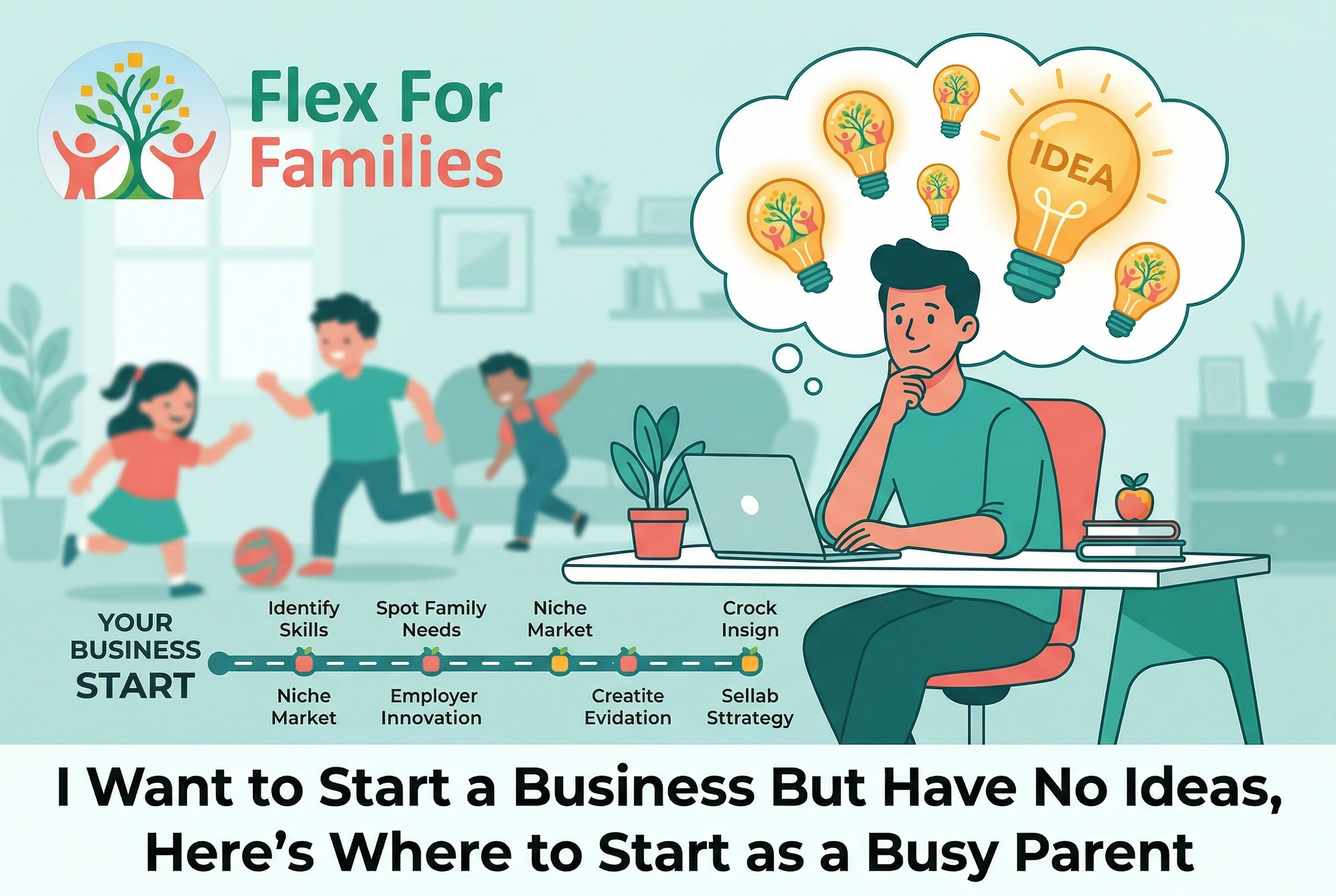
You’re sitting there thinking, “I want to start a business, but I have no ideas.”
You’re not lazy. You’re not behind. You’re just stuck at the hardest part, where everything feels possible, and that makes it harder to choose.
If you’re a busy parent, this feels even heavier.
You don’t have hours to test random ideas. You don’t want to waste money. You need something that actually fits around your life, not something that adds more stress to it.
That’s exactly what this guide will help you do.
You’ll learn how to stop overthinking, how to find ideas that actually suit your situation, and what realistic options look like when your time is limited.
No hype. No complicated steps. Just a clear way forward.
Why Most People Get Stuck at This Stage
This is where most people give up, and it’s not because they can’t start a business.

It’s because they try to start in the wrong place.
Too many choices slow you down
Search “business ideas” and you’ll see hundreds of options.
Dropshipping. Coaching. Amazon FBA. Etsy. Freelancing.
It sounds helpful, but it creates pressure.
You feel like you need to pick the perfect idea straight away. That leads to hesitation, and then nothing happens.
Fear of choosing the wrong idea
You start thinking:
- What if it doesn’t work
- What if I waste money
- What if I pick something I don’t enjoy
This fear keeps you researching instead of starting.
Most successful people did not pick the perfect idea first. They picked something simple and adjusted as they went.
Time feels like your biggest barrier
If you’re juggling work, school runs, and everything else, your time is limited.
So every decision feels bigger.
You’re not just choosing a business idea. You’re choosing where your time goes.
That’s why quick wins and simple setups matter more for you than complex business models.
You’re trying to start with the idea instead of your life
This is the biggest mistake.
Most advice tells you to “find a profitable idea.”
But that ignores your reality.
- How much time do you actually have each day
- What energy do you have left at the end of the day
- What you enjoy enough to stick with
If the idea does not fit your life, it will not last.
The shift that changes everything
Instead of asking:
“What business should I start?”
Ask:
“What kind of business fits my life right now?”
That one shift removes pressure and makes the next step clear.
Step 1: Start With Your Situation, Not a Business Idea
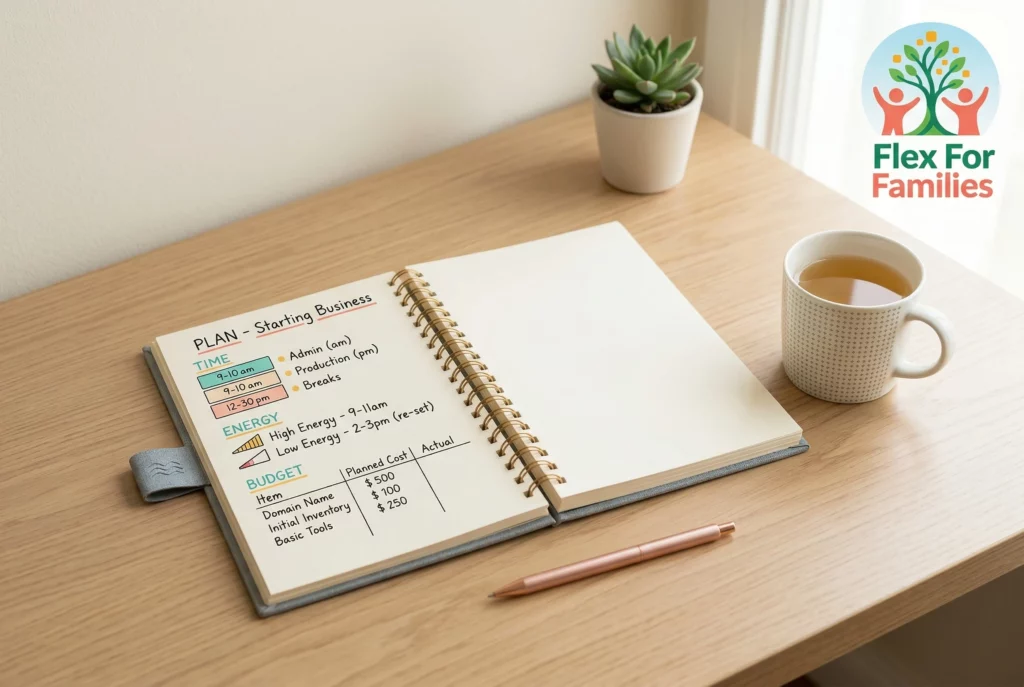
Most people skip this step.
They jump straight into searching for ideas, hoping something clicks.
That’s why they stay stuck.
If you want something that actually works, you need to start with your reality first.
How much time do you actually have?
Be honest here.
Not your ideal schedule. Your real one.
- 30 minutes a day during nap time
- 1 hour in the evening
- A few hours at the weekend
Even 30 minutes a day adds up.
That’s 3.5 hours a week. Over a month, that’s 14 hours.
That is enough to start something simple.
If you try to build a business that needs 3 to 4 hours a day, it will not last.
What energy do you have left?
Time matters. Energy matters more.
At the end of the day, you are not at your best.
So your business needs to match that.
Good fits:
- Writing short blog posts
- Researching simple topics
- Creating basic content
- Learning step by step
Harder to sustain:
- Cold calling
- High pressure sales
- Complex setups with lots of moving parts
If it feels draining from day one, you will avoid it.
What budget can you realistically start with?
You do not need thousands to get started.
Keep this simple.
- £0 to £50. You can start learning, planning, and testing ideas
- £50 to £100. You can cover a domain and basic tools
- £100+. You have more flexibility, but still keep it lean
Starting small reduces risk.
It also removes pressure to “make your money back” quickly.
What skills or experience can you lean on?
You do not need expert level skills.
You just need a starting point.
Think about:
- Writing. Emails, posts, simple guides
- Organisation. Planning, structuring, managing tasks
- Research. Finding answers and simplifying them
- Life experience. Parenting, routines, budgeting, school life
These are valuable.
You can build something around them.
What can you stick with for the next 3 months?
This is the filter most people ignore.
Ask yourself:
- Can I see myself doing this 3 times a week
- Would I still do this if results are slow
- Does this feel simple enough to repeat
You do not need passion.
You need something you will not quit after two weeks.
Your simple starting point
Before you look at any business ideas, write this down:
- Time available each day or week
- Energy level. Low, medium, high
- Budget range
- Skills or interests
This becomes your filter.
Now, when you look at ideas, you will not feel overwhelmed.
You will quickly see what fits and what does not.
This step saves you weeks of going in the wrong direction.
Next, we will use this to narrow down actual business ideas that make sense for your situation.
Step 2: Use These 3 Simple Paths to Find a Business Idea
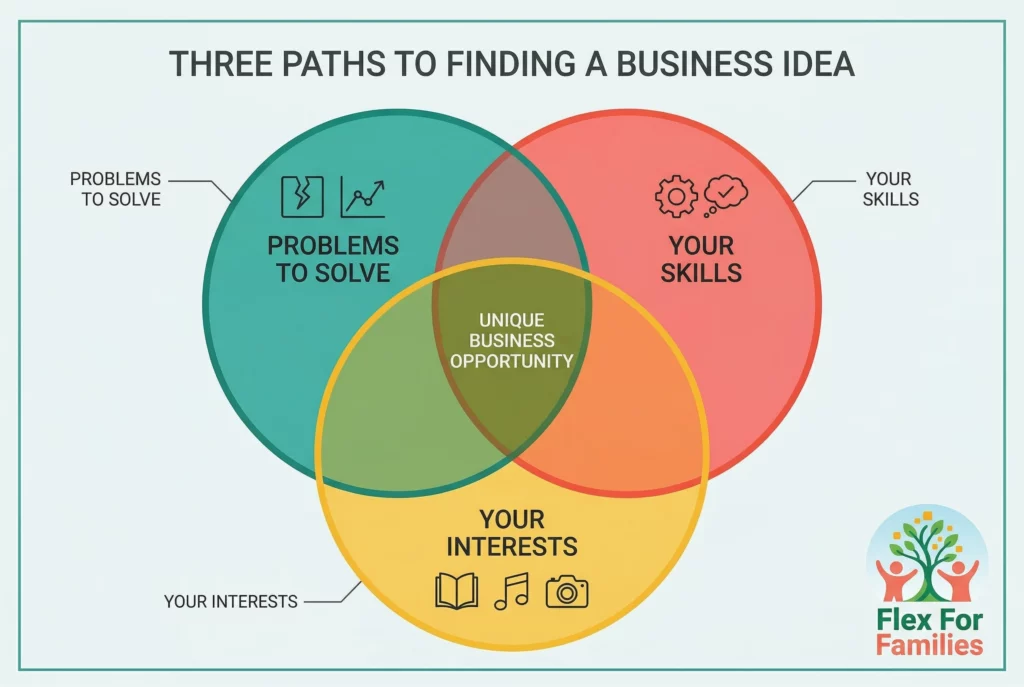
You don’t need a “perfect” idea.
You need a starting point that fits your situation.
These three paths make that simple.
Path 1: Problem-Based Ideas
Start with problems you already understand.
These are often the easiest to turn into something useful.
Think about your daily life:
- What slows you down
- What frustrates you
- What you had to figure out the hard way
For example:
- Struggling to keep kids in a routine
- Finding quick meal ideas
- Managing time as a parent
Each of these can turn into:
- Blog content
- Digital products
- Affiliate recommendations
People search for solutions every day.
If you can help solve a small problem, you have a business idea.
Path 2: Skill-Based Ideas
Look at what you can already do.
You do not need to be an expert. You just need to be one step ahead of someone else.
Common skills that work well:
- Writing simple, clear content
- Researching and explaining things
- Organising information
- Creating basic graphics or checklists
These can turn into:
- Freelance writing
- Blogging
- Virtual assistant work
- Content creation
This path works well if you want to start quickly.
You are building on something you already have.
Path 3: Interest-Based Ideas
This is about what you enjoy enough to keep going.
You do not need passion. You need interest.
Ask yourself:
- What do I enjoy learning about
- What do I search for regularly
- What could I talk about without getting bored
Examples:
- Parenting routines
- Budgeting and saving money
- Kids activities
- Fitness at home
These can grow into:
- Niche blogs
- YouTube or Pinterest content
- Affiliate marketing
Interest keeps you consistent when results are slow.
How to choose between the three
You do not need to pick just one.
The best ideas usually sit in the overlap.
For example:
- Problem: No time as a parent
- Skill: Writing simple guides
- Interest: Helping other parents
That becomes:
A parenting blog focused on simple routines and time management.
Quick exercise to make this real
Take 5 minutes and write:
- 3 problems you deal with regularly
- 3 skills you already use
- 3 things you enjoy or want to learn
Now look for overlaps.
That is your starting point.
This removes the pressure of “finding the perfect idea.”
You are building something around your life, not guessing.
Next, we will turn this into real business ideas you can actually start, even with limited time.
Step 3: 10 Realistic Business Ideas for Busy Parents
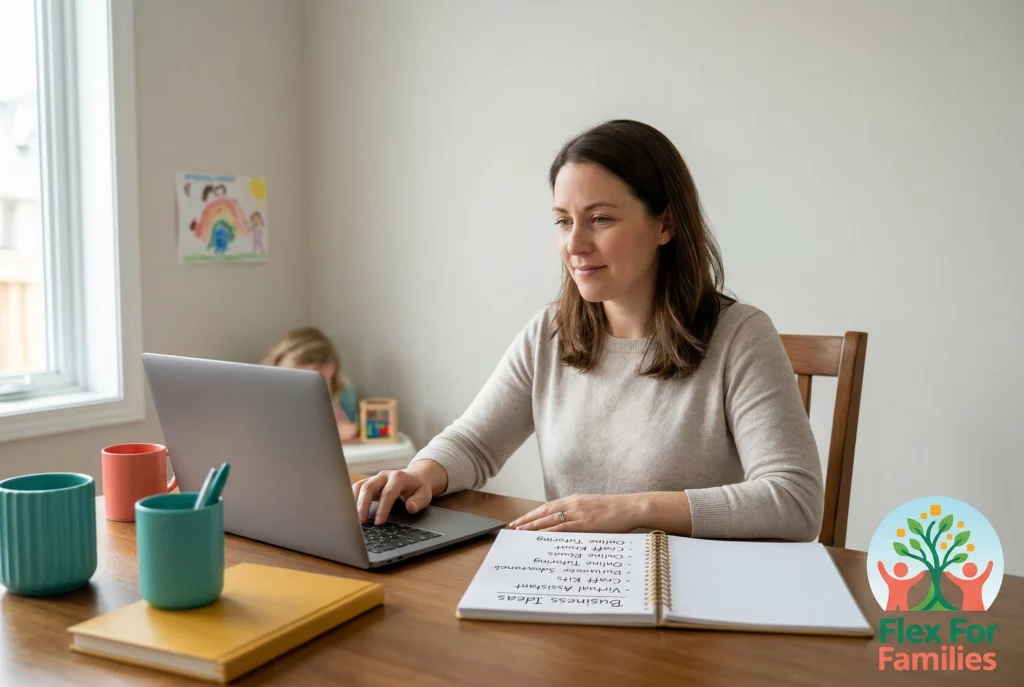
You don’t need complicated models or big investments.
You need simple ideas that fit into your time and can grow over time.
Here are 10 you can actually start.
1. Start a Parenting Blog
You write about real experiences and solutions.
- Share routines, tips, and lessons
- Help other parents solve small problems
- Add affiliate links to tools and resources
Cost can be under £100 to start.
This is one of the most flexible options.
2. Affiliate Marketing
You recommend products or platforms you trust.
- Write reviews
- Create simple guides
- Share what works for you
You earn when someone signs up or buys through your link.
No product. No customer service.
3. Pinterest Management
Many bloggers need help with Pinterest.
- Create pins
- Schedule content
- Help grow traffic
You can learn the basics in a few weeks and charge £200 to £500 per client per month.
4. Freelance Writing
You write content for websites or blogs.
- Blog posts
- Email content
- Website pages
Beginner rates can start at £30 to £50 per article. This can grow quickly with experience.
5. Sell Printables on Etsy
You create simple digital products.
- Checklists
- Planners
- Kids activity sheets
Create once, sell multiple times.
Tools like Canva make this easy to start.
6. Virtual Assistant Work
You support small businesses with simple tasks.
- Email management
- Scheduling
- Basic admin
Many parents start at £10 to £15 per hour and increase rates over time.
7. Niche Review Website
You focus on reviewing products in one area.
- Baby gear
- Budget tools
- Online courses
You help people make decisions and earn through affiliate links.
8. Local Service Business
Simple services still work well.
- Cleaning
- Dog walking
- Tutoring
You can start quickly and earn straight away.
This is less flexible but faster for income.
9. Reselling
Buy low, sell higher.
- Clothes
- Toys
- Household items
Use platforms like eBay or Facebook Marketplace.
Good for quick cash. Harder to scale long term.
10. Simple Digital Products
Beyond printables, you can create:
- Short guides
- Templates
- Mini courses
You build once and sell over time.
How to choose the right one
Do not overthink this.
Use what you wrote in Step 1.
Ask:
- Does this fit my time
- Can I do this with my energy levels
- Is the startup cost realistic
- Can I see myself doing this for 3 months
Pick one. Start small.
What matters most right now
You are not choosing your forever business.
You are choosing your starting point.
Most people stay stuck because they never move past this step.
You only need one idea that fits your life today.
Next, we will look at the safest option if you still feel unsure, and how to reduce risk while you figure things out.
Thinking Blogging Might Be the Right Fit?
If you like the idea of building something flexible from home, blogging could be one of the best places to start. It gives you a low cost way to share helpful content, grow traffic, and learn affiliate marketing at your own pace.
I’ve pulled together my best beginner friendly guides inside the Parent Blogging Hub, so you can see how it all works without feeling overwhelmed.
Step 4: The Safest Option If You Feel Unsure
If you’re still thinking, “What if I pick the wrong thing?” you’re not alone.
This is where most people hesitate.
So instead of chasing the “best” idea, focus on the safest way to start.
What “safe” actually means here
A safe business option should:
- Cost very little to start
- Fit into short time blocks
- Not rely on stock or upfront buying
- Let you learn as you go
- Give you room to change direction
That rules out a lot of complex models straight away.
Why blogging with affiliate marketing fits this
This is why blogging paired with affiliate marketing works so well for busy parents.
- You can start with 30 to 60 minutes a day
- You do not need to create your own product
- You do not deal with customers or shipping
- You can build it slowly around your schedule
It is simple to start, but it can grow into something much bigger over time.
What it looks like in practice
You create helpful content based on problems people are searching for.
For example:
- “How to manage time as a busy parent”
- “Best tools for starting a blog”
- “Ways to make money from home as a parent”
Within that content, you recommend tools or platforms that help.
When someone signs up through your link, you earn a commission.
Why this reduces risk
You are not locked into one idea.
You can:
- Test different topics
- See what people respond to
- Adjust as you learn
If one idea does not work, you pivot. You do not start from scratch.
That flexibility matters when your time is limited.
Realistic expectations
This is not instant income.
Most people see:
- First signs of traffic in 1 to 3 months
- First earnings in 3 to 6 months
The upside is long term.
Once content ranks, it can bring in traffic and income without constant effort.
Why this fits your situation
If you are a busy parent:
- You need flexibility
- You need low pressure
- You need something you can pause and return to
Blogging gives you that.
You build it around your life, not the other way round.
If this feels like the right direction
This is where I’d point you next.
If you want a simple, step by step way to start a blog and learn affiliate marketing, take a look at my full breakdown here:
Both will walk you through exactly how this works and what to expect.
Next, we will look at how to test any idea without risk, so you can move forward with confidence instead of guessing.
Want a Simple Way to Start?
If blogging and affiliate marketing feel like the safest fit for your life right now, the Parent Blogging Hub is the best next step. It walks you through the basics in plain English, with practical posts designed for busy parents.
You do not need to figure this out on your own. Start with the guides that help you choose your direction, set up your blog, and make progress in the time you have.
Step 5: How to Test an Idea Without Risk
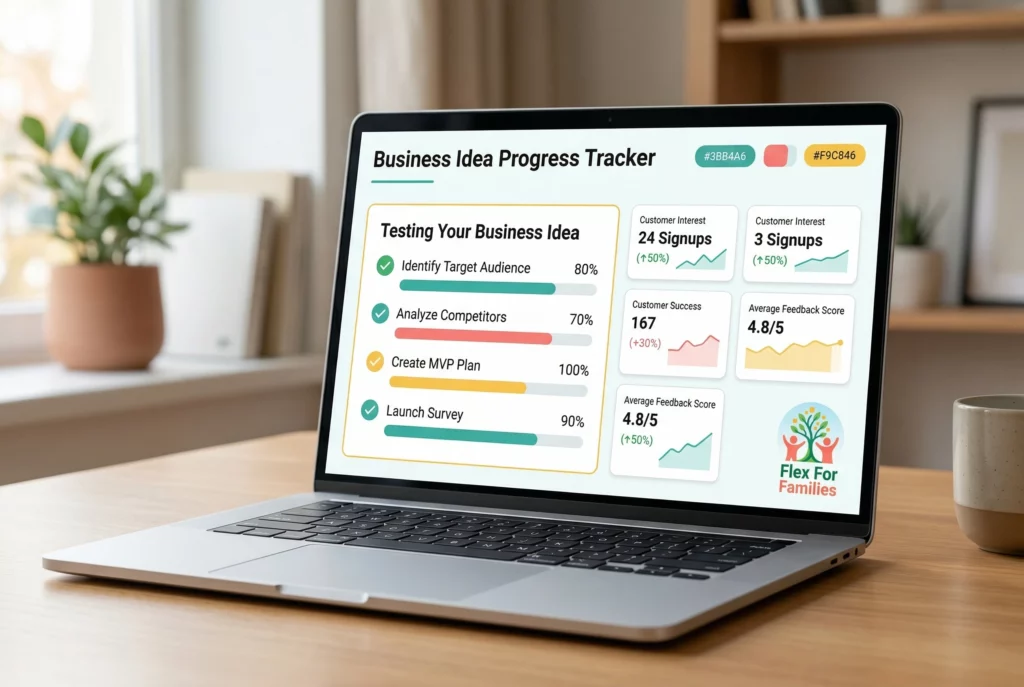
You do not need to commit fully to a business idea on day one.
You just need to test it.
This is how you move forward without wasting time or money.
The goal of testing
You are not trying to make money straight away.
You are looking for signs:
- Do I enjoy this
- Can I stay consistent
- Are people interested
That’s it.
# 1: Create 3 simple pieces of content
Keep this small and manageable.
For example:
- 3 blog posts
- 3 Pinterest pins
- 3 short guides or social posts
Focus on solving one clear problem each time.
Example topics:
- “How to find time to start a business as a parent”
- “Simple ways to make extra money from home”
- “Best beginner ideas for busy parents”
Do not aim for perfect. Aim for done.
#2: Share it where your audience already is
You do not need a huge following.
Start simple:
- Facebook groups
- Your own social profiles
You are looking for small signals.
Even a few clicks or saves is a good sign.
#3: Watch what gets attention
After a week or two, look at:
- Which posts get clicks
- What people engage with
- What questions come back
You do not need hundreds of views.
If 10 people click and 2 engage, that is useful feedback.
#4: Do more of what works
This is where most people go wrong.
They jump to a new idea too quickly.
Instead:
- If one topic gets attention, create more like it
- If something feels easy to create, lean into it
- If something feels draining, drop it
Progress comes from repeating what works.
#5: Keep your risk low
You should not need to spend much at this stage.
- Use free tools where possible
- Avoid buying courses too early
- Focus on learning by doing
Your only real investment is your time.
What success looks like here
Success is not income yet.
It looks like:
- You showed up consistently for 2 to 4 weeks
- You created content without overthinking
- You saw small signs of interest
- You feel clearer about what direction to take
That is progress.
Why this step matters
This removes pressure.
You are no longer guessing.
You are testing, learning, and adjusting.
That is how real businesses are built.
From here, you are no longer someone “looking for ideas.”
You are someone taking action and building something that fits your life.
Ready to Take the Next Step?

If you’ve made it this far, you’re no longer stuck.
You have:
- A clear way to find ideas that fit your life
- Simple options you can start with
- A low risk way to test what works
Now it’s about taking that first step.
If you want a simple path to follow
If blogging and affiliate marketing feel like the right fit, I’ve put together a step by step guide to help you get started.
Inside, you’ll see:
- How to choose your blog focus
- What to set up first
- How to create content that gets traffic
- How to turn that traffic into income
You can explore that here:
If you want to see the platform I recommend
I use Wealthy Affiliate because it keeps everything in one place.
It includes:
- Beginner friendly training
- Website hosting
- Keyword research tools
- A community that helps when you get stuck
If you want a full breakdown of how it works and what to expect, you can read my review here:
Ready to Start Your Blog the Right Way?
If you want a simple, step by step way to start a blog and learn affiliate marketing, Wealthy Affiliate gives you everything in one place. No guesswork. No overwhelm. Just a clear path you can follow at your own pace.
You’ll get beginner friendly training, website hosting, keyword tools, and a supportive community that helps you stay on track, even with limited time.
- Start with no experience
- Build around your schedule
- Learn as you go with real support
If you need something quick to get started
If time is your biggest challenge, start with something small.
My Nap Time Blogging Checklist gives you a simple way to use short pockets of time and still make progress.
→ Get the Nap Time Blogging Checklist
Want to Start a Business But Have No Ideas: FAQ Section
What should I do if I want to start a business but have no ideas?
Start by looking at your time, budget, and skills. Focus on simple ideas that fit your daily life. Use problem based, skill based, or interest based paths to find a starting point. Test one idea with small steps before committing time or money.
How do I choose the right business idea?
Choose an idea that fits your time, energy, and budget. It should be simple to start and easy to repeat. You do not need the perfect idea. You need one you can stick with for at least a few months.
Can I start a business with no experience?
Yes. Many people start with no experience. Focus on learning as you go. Start with simple tasks like writing, researching, or sharing what you learn. Skills build over time through action.
What is the easiest business to start from home?
Blogging with affiliate marketing is one of the easiest options. It has low startup costs, flexible hours, and no need to manage products or customers. You can build it step by step around your schedule.
How much money do I need to start a business?
You can start with very little. Many online business ideas can begin with £0 to £100. Start small, test your idea, and only invest more once you see progress.
How long does it take to make money from a business?
It depends on the type of business. Some local services can earn quickly. Online businesses like blogging often take 3 to 6 months to see results. Focus on consistency rather than speed.
What if I choose the wrong business idea?
You can change direction. Starting small allows you to test ideas without risk. If something does not work, use what you learned and adjust. You are not locked in.
How can I start a business with limited time as a parent?
Use short time blocks. Even 30 minutes a day is enough to make progress. Choose a business model that is flexible and can be paused and restarted easily, like blogging or freelance work.
Let’s Chat
What’s been holding you back from starting?
Is it time, ideas, or not knowing where to begin?
Drop a comment and let me know.
I read every message, and I’m happy to help you figure out your next step.