
If you’ve ever looked at an MLM, you’ve probably come across something called a compensation plan.
It usually looks like a chart filled with levels, ranks, and bonuses.
At first glance, it can feel complicated.
Most parents don’t have time to sit and figure out what it all means. So they rely on what they’re told.
And that’s where confusion can start.
Because while the charts look complex, the way MLMs actually pay is much simpler.
Once you understand the basics, you can quickly see:
- Where money really comes from
- What you would need to do to earn it
- Whether it fits around your life
This guide breaks it down step by step, in plain English, so you can make a clear and informed decision.
Thinking About an MLM?
Before you join, explore my MLM for Parents guide. It walks you through how MLMs work, the risks to watch for, and how they compare to other flexible income options for families.
Visit the MLM for Parents GuideWhat Is an MLM Compensation Plan?
An MLM compensation plan is simply the system a company uses to pay you.

It explains:
- How you earn from selling products
- How you earn from other people in your team
- What you need to do to qualify for bonuses or higher earnings
Every MLM has its own version.
They use different names, different charts, and different layouts.
But most of them are built on the same core idea.
You are paid based on two things:
- Your own activity
- The activity of people you bring into the business
That’s it.
Everything else in the plan is just a way of organising those two parts.
Most plans will include:
- Levels or tiers
- Titles or ranks
- Targets you need to hit
These are used to:
- Track progress
- Unlock bonuses
- Increase earning potential
But they can also make the plan feel more complicated than it really is.
When you strip it back, the key question is always the same:
Where is the money actually coming from?
Once you understand that, the rest of the compensation plan becomes much easier to follow.
Let’s look at the main ways you actually get paid.
If you’re new to MLMs, it may also help to read why MLMs appeal to stay-at-home parents to understand how these opportunities are usually presented.
The Three Main Ways You Get Paid
Most MLM compensation plans are built around three main income streams.

Once you understand these, you understand how almost every MLM works.
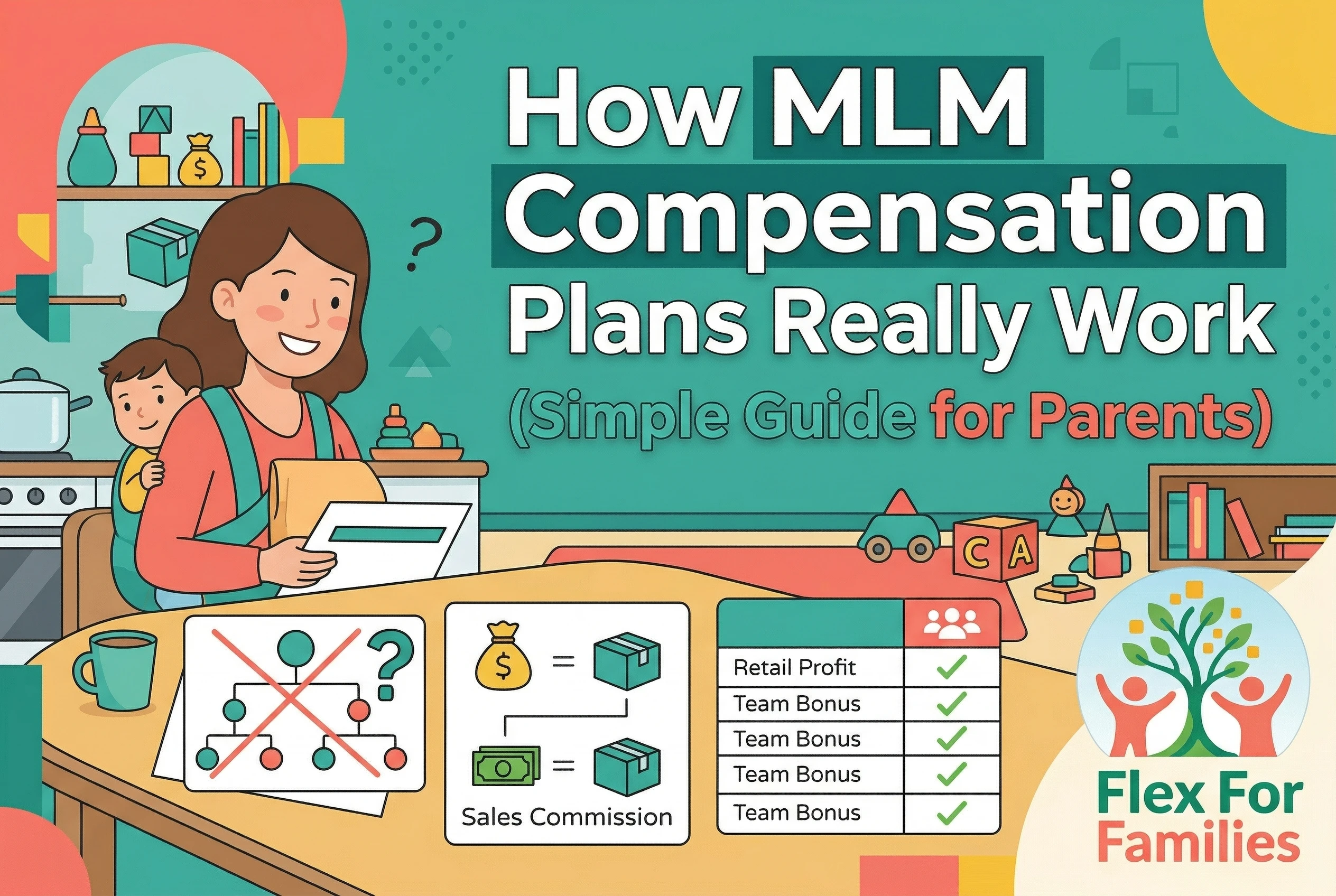
1. Retail Profit
This is the most straightforward way to earn.
You:
- Buy products at a discounted price
- Sell them at the retail price
- Keep the difference
Simple Example
- You buy a product for £20
- You sell it for £30
- Your profit is £10
That’s a 33 per cent margin.
What This Looks Like in Practice
This is how many parents expect to earn at the start.
It feels simple. No team. No pressure to recruit.
But there are a few things to be aware of:
- Margins are often lower than expected, typically 10 to 30 percent
- You need consistent sales to generate steady income
- You are responsible for finding customers
Reality Check
Let’s say your average profit per sale is £5.
To earn £250 in a month, you would need:
- 50 sales
That’s:
- More promotion
- More conversations
- More time
Retail profit is real. But on its own, it can be slow to build.
2. Team Commissions
This is where MLMs differ from traditional selling.
When you bring someone into the business, they become part of your team.
If they sell products, you may earn a percentage of their sales.
This can continue across multiple levels.
How It Works
You might earn from:
- People you recruit directly
- People they recruit
- And sometimes several levels below that
This structure is often called your “downline.”
Simple Example
- You recruit 3 people
- Each person sells £500 of products per month
- You earn 5 percent from their sales
That gives you:
- £75 per month from your team
Now scale that across more people and levels, and income can grow.
Why This Matters
This is where most MLMs generate larger earnings.
Because you are no longer relying only on your own sales.
You are earning from a group.
Reality Check
Building a team usually requires:
- Recruiting consistently
- Supporting new members
- Helping them stay active
This adds time and responsibility.
For many parents, this is where the model starts to feel different from what they expected
3. Bonuses and Incentives
This is where compensation plans can start to feel more complex.
Most MLMs offer bonuses based on performance.
These are designed to reward activity and growth.
Common Types of Bonuses
You may see:
- Volume bonuses based on total sales
- Rank bonuses for reaching certain levels
- Fast-start bonuses for early activity
What You Need to Qualify
To earn these, you often need to meet targets such as:
- A minimum level of personal sales
- A certain level of team activity
- Maintaining your rank each month
Simple Example
- You need £1,000 in total sales to qualify for a bonus
- This could include your sales and your team’s
If you hit that target, you unlock additional earnings.
Reality Check
Bonuses can look attractive.
But they often depend on:
- Consistent performance
- Ongoing activity
- Meeting specific targets every month
If those targets are not met, the bonuses stop.
Bringing It All Together
Most MLM income is a mix of:
- Retail profit from your own sales
- Commissions from your team
- Bonuses based on performance
The key question is:
Which of these makes up the majority of the income?
In many cases, it’s the team-based commissions and bonuses.
That’s why recruiting and team building are often encouraged, even if it’s not presented as the main focus.
Now that you understand how the money flows, the next step is to look at why compensation plans can feel confusing in the first place.
This is where many parents start to feel unsure.
Why MLM Compensation Plans Can Feel Confusing
If you’ve ever looked at a compensation plan and felt lost, you’re not alone.
They are often presented in a way that feels more complicated than it needs to be.
The Use of Charts and Diagrams
Most MLMs show their plans using:
- Boxes
- Lines
- Levels
- Trees or structures
These diagrams are designed to show how people are connected.
But they don’t always clearly show how money flows.
So instead of clarity, they can create confusion.
Different Names for the Same Thing
Each company uses its own terminology.
You might see:
- Downline or team
- Upline or sponsor
- Volume or points
- Rank or level
The names change, but the meaning is often the same.
This makes it harder to compare one MLM to another.
Focus on Potential, Not Typical Outcomes
Most plans highlight:
- What is possible
- How income can grow
- What top earners achieve
But they don’t always show:
- What the average person earns
- How long it takes to reach higher levels
- How many people do not progress
This creates an expectation gap.
Bonuses Add Layers of Complexity
Bonuses are often tied to:
- Specific targets
- Team performance
- Monthly requirements
Each bonus has its own rules.
And these rules can change depending on your rank.
So instead of one simple income stream, you end up tracking multiple conditions.
The Key Problem
The structure itself is not the issue.
The issue is how it is presented.
You are often shown:
- The full system
- All levels
- All possible earnings
Before you understand the basics.
A Simpler Way to Look at It
To make sense of any compensation plan, ignore the diagrams at first.
Ask these four questions:
- How much can I earn from selling products?
- How much comes from recruiting and team activity?
- What do I need to do every month to stay active?
- What happens if I stop for a while?
If you can answer these clearly, you understand the plan.
If you can’t, that’s a sign to pause and look deeper.
What This Means for Parents
For parents, clarity matters more than complexity.
You don’t need to understand every level or bonus.
You need to understand:
- How much time it will take
- How predictable the income is
- Whether it fits around your family
Because even a well-structured plan can feel overwhelming if it doesn’t match your lifestyle.
A Real Example
If you want to see how this looks in practice, I break it down in my Utility Warehouse review, including how the structure affects real earning potential.
Now that you understand how compensation plans work and why they can feel confusing, the next step is to look at where most people actually earn within these structures.
This is where expectations and reality often differ.
Where Most People Actually Earn
Now that you understand how MLMs are structured, the next question is simple.
Where does most of the money actually come from?
On paper, you have three income streams:
- Retail profit
- Team commissions
- Bonuses
But in practice, they don’t all carry the same weight.
Retail Profit Is Usually the Starting Point
Most people begin by selling products.
This is the easiest part to understand.
But for many, it becomes clear that:
- Margins are limited
- Sales take time to build
- Income can be inconsistent
Retail profit can work as a small income stream.
But it is rarely where larger earnings come from.
Team Commissions Drive Most Growth
In many MLMs, the bigger income comes from team activity.
Once you build a team:
- You earn from multiple people
- Sales volume increases
- Bonuses become easier to reach
This is why recruiting is often encouraged.
Not because selling is unimportant.
But because team-based income scales more easily.
Bonuses Depend on Hitting Targets
Bonuses can boost income.
But they usually depend on:
- Monthly performance
- Sales volume
- Team activity
If those targets are not met, bonuses drop off.
So while they can increase earnings, they are not always stable.
The Pattern Most People Experience
For many parents, the journey looks like this:
- Start with product sales
- Realise income is limited
- Get encouraged to build a team
- Take on more activity and responsibility
This shift is not always obvious at the start.
But it becomes clear over time.
Why This Matters
If your goal is:
- Simple extra income
- Flexible hours
- Low pressure
Then it’s important to understand where income is really coming from.
Because if most earnings rely on team growth, the role becomes more involved than expected.
Connecting This Back to What You’ve Seen
This ties into what we’ve already covered.
- Why MLMs appeal to stay-at-home parents
- What most parents are not told before joining
- Whether you can earn without recruiting
- The signs that an MLM might be high risk
If you haven’t read those yet, they will give you a fuller picture of how this works day to day.
A Simpler Way to Think About It
Strip everything back and it comes down to this.
- Selling = direct effort, limited scale
- Team building = more scale, more responsibility
Every MLM sits somewhere between those two.
Your experience depends on which side you lean into.
So before you join any MLM, it’s worth stepping back and asking a simple question.
Does this structure actually fit the way you want to earn?
Let’s look at that next.
Does This Structure Fit Around Family Life?
Now that you understand how MLM compensation plans work, the next step is personal.
Not “can it work?”
But “does it work for you?”
What This Looks Like Day to Day
Based on how MLMs are structured, earning usually involves:
- Regular product promotion
- Ongoing conversations
- Following up with people
- Supporting a team if you build one
Even with flexible hours, this often means staying active most days.
The Key Trade-Off
MLMs offer:
- A quicker way to get started
- A structured system to follow
- The chance to earn from a team
But in return, they often require:
- Consistency
- Communication
- Ongoing activity
For some parents, that works well.
For others, it feels like another commitment on top of an already full day.
Questions to Ask Yourself
Before joining, it helps to be honest about what you want.
- Do I want to rely on selling and conversations?
- Am I comfortable building and managing a team?
- Can I stay consistent week after week?
- Does this fit around my current routine?
If the answer to any of these feels uncertain, it’s worth pausing.
A Simpler Way to Build Income
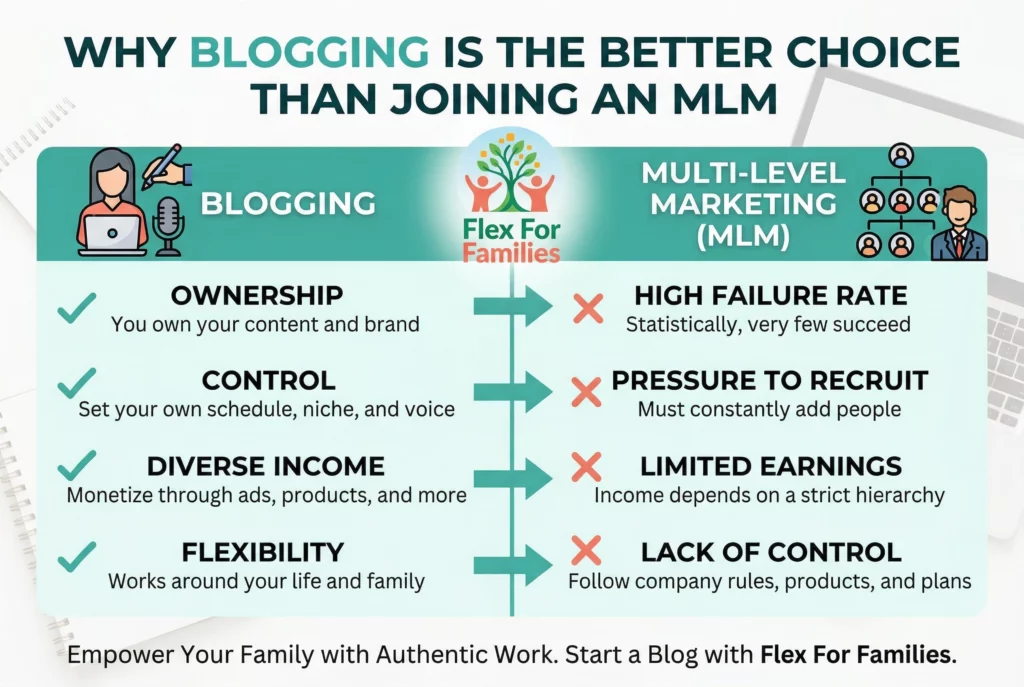
If you’re looking for something that:
- Does not rely on recruiting
- Does not require daily outreach
- Can grow over time
- Then blogging is worth considering.
Instead of working within a structure, you create your own.
You:
- Build content
- Help people through your experience
- Earn through recommendations
There’s no team to manage.
No need to message people.
And no complex compensation plan to figure out.
Want to See How This Could Work?
Start Building Something Simpler
Visit the Parent Blogging Hub to learn how you can build a flexible income step by step, even with a busy family schedule.
Explore the Blogging HubSee the Platform I Recommend
Wealthy Affiliate gives you the tools and training to build your blog at your own pace.
Read My Full ReviewLet’s Chat
Did you find MLM compensation plans easy to understand, or did they feel confusing at first?
And more importantly, does this type of structure feel like something that would fit your life right now?
Drop a comment and share your thoughts.