


If you are a parent trying to grow blog traffic, the advice online can feel unrealistic fast.
Post every day. Be on every platform. Pin constantly. Post reels. Write long guides. Update old posts. Do keyword research every week.
That advice assumes time you do not have.
Most parents are not stuck because they are lazy or inconsistent. They are stuck because they are trying to follow strategies designed for full-time creators.
Limited time does not mean limited results. It means you need a different approach.
This post is about growing blog traffic in a way that works around family life. No hacks. No pressure. Just what actually moves traffic forward when your time comes in short, unpredictable windows.
Why Traffic Growth Feels Harder as a Parent
Traffic growth feels harder for parents because time is fragmented.
You do not sit down for four focused hours. You work in pockets. Thirty minutes here. An hour there. Then life interrupts.
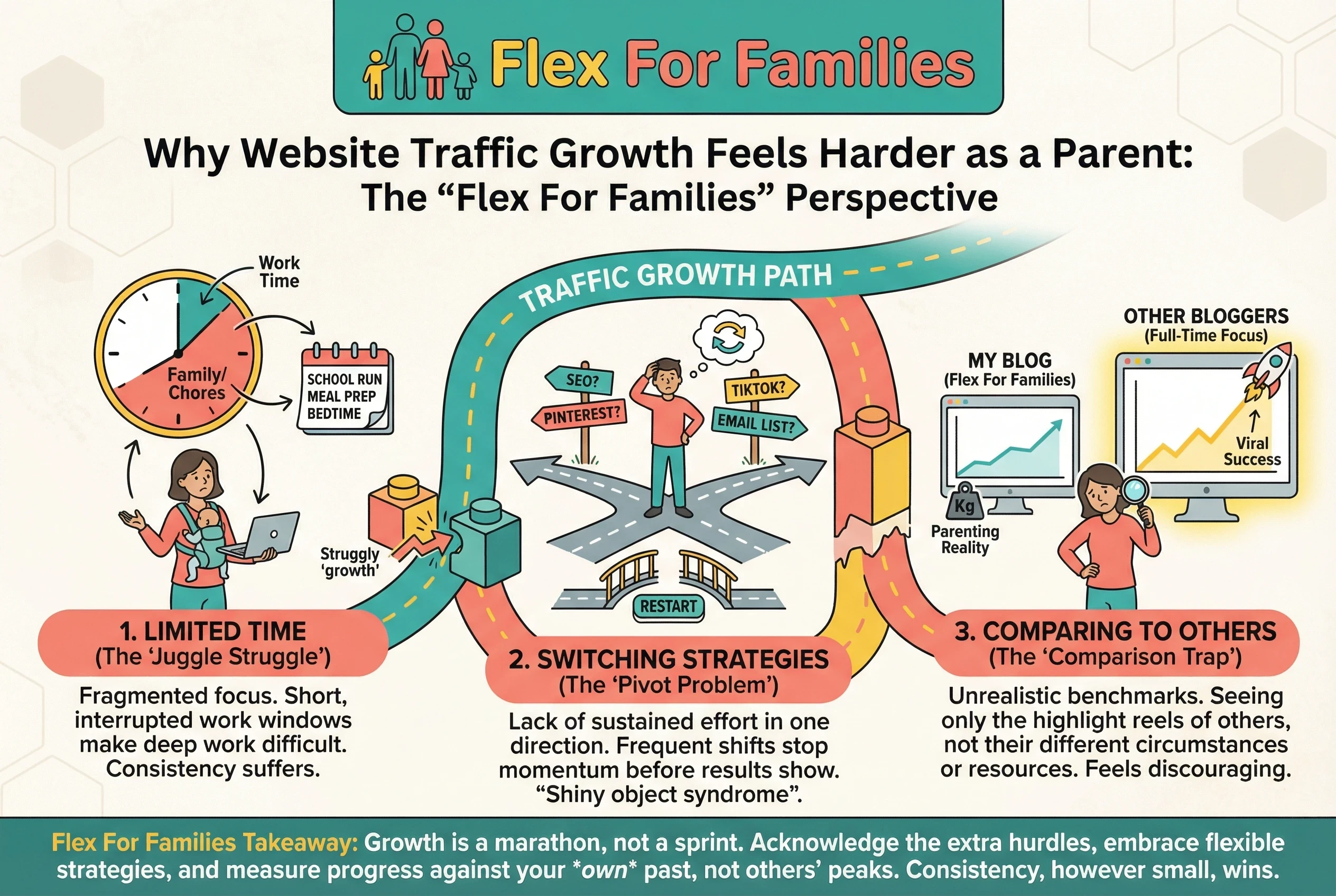
That creates a few common problems.
You switch strategies too often
When progress feels slow, it is tempting to jump to something new. Pinterest this month. SEO next month. Back to social the month after. Traffic never has time to compound.
You measure yourself against the wrong people
Most success stories come from people working full-time on their blogs. Comparing your progress to theirs makes normal growth feel like failure.
You mistake activity for progress
Posting more does not always mean growing faster. Busy work feels productive, but it often spreads effort too thin.
You restart instead of building
Parents often stop and restart strategies when life gets busy. Traffic growth usually comes from continuing, not restarting.
The issue is rarely effort. It is a focus.
Once you stop trying to do everything and start doing fewer things consistently, traffic growth becomes calmer and more predictable.
What Actually Moves Traffic with Limited Time
When time is limited, traffic growth comes from focus, not volume.
Most parents try to grow traffic by doing more. More posts. More platforms. More tactics. That approach usually backfires because nothing gets enough time to work.
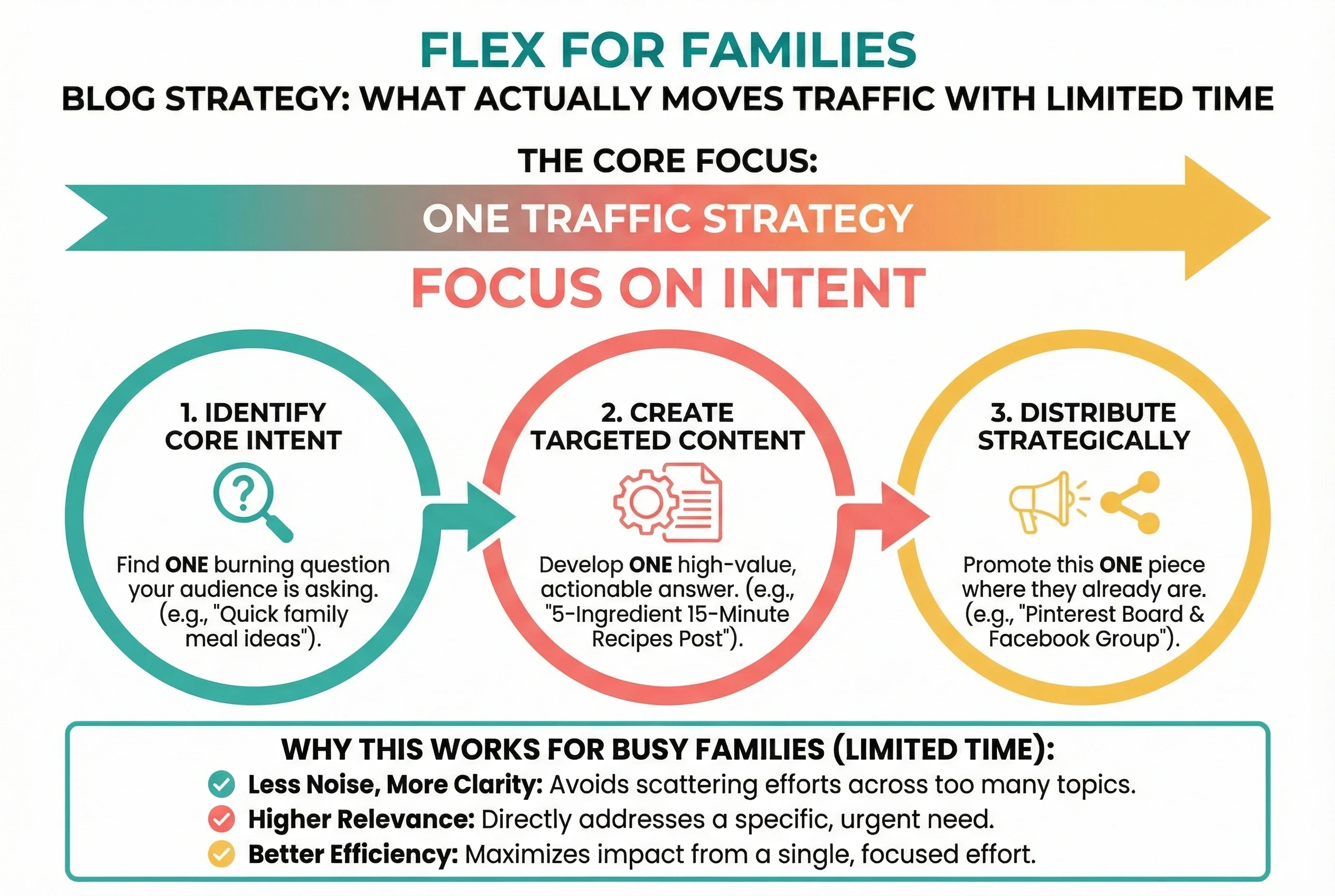
What moves traffic with limited time is doing fewer things, better.
Focus on intent, not output
One post that answers a clear question can outperform ten general posts. Traffic grows when content matches what people are already searching for, not when you publish more often.
This is why strategy posts like Blogging Courses vs Affiliate Marketing Courses and Pinterest Traffic Courses vs SEO tend to perform better. They solve a specific problem for a specific reader.
Choose one traffic strategy at a time
Trying to grow SEO, Pinterest, Instagram, and email all at once spreads effort too thin. Pick one primary traffic source and commit to it for at least 60 to 90 days.
For most parents, SEO works best because content keeps working even when you step away.
Work on compounding tasks
Compounding work keeps paying off after you stop working on it.
Examples include:
- Writing search-focused blog posts
- Improving existing content instead of starting from scratch
- Building internal links between related posts
These tasks move traffic even when progress feels slow.
Let traffic build quietly
Traffic growth often happens without obvious signals at first. Rankings improve before clicks do. Impressions grow before traffic shows up.
Parents who stick with one strategy long enough usually see traffic move. Parents who keep restarting rarely do.
Limited time does not stop traffic growth. Scattered effort does.
Why SEO is the Best Foundation for Busy Parents
SEO works better for busy parents because it rewards build once, benefit later effort.
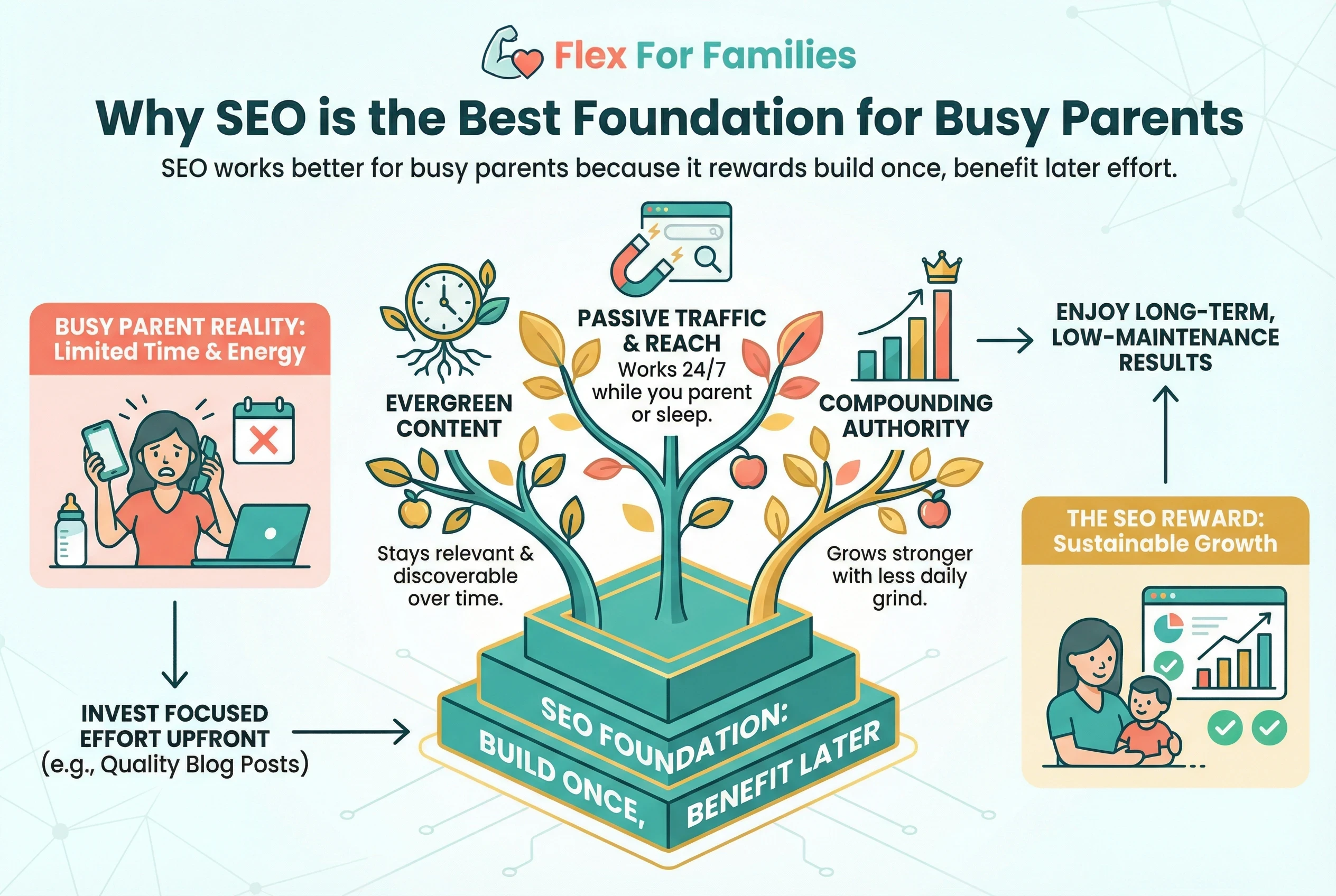
When you publish a helpful, search-focused post, it does not disappear when you log off. It can bring traffic weeks, months, or even years after you wrote it. That matters when your schedule changes often.
SEO does not require daily activity
Unlike social platforms, SEO does not punish you for missing days or weeks. Once a post is live, it keeps working while you focus on family or other priorities.
For parents, this removes pressure. You can step away without resetting progress.
SEO fits short work sessions
SEO-friendly posts can be written in parts. Research one day. Draft another. Edit later. You do not need long creative blocks to make progress.
This makes it easier to work in 30 to 60-minute windows.
SEO compounds over time
Each post strengthens the next one. Internal links connect content. Authority builds gradually. Traffic grows quietly in the background.
This compounding effect is why parents often see traffic increase months after they stop obsessing over it.
SEO supports monetisation naturally
Search traffic brings readers who are actively looking for answers or solutions. That makes monetisation easier later, whether through affiliates, ads, or products.
This is why many parents learn SEO through platforms like Wealthy Affiliate, where SEO and monetisation are taught together in a flexible way.
SEO is slower at the start. That part is true. But it is calmer, more forgiving, and easier to maintain long-term.
For busy parents, that trade-off is usually worth it.
How Many Posts Parents Actually Need to Grow Traffic
One of the biggest myths in blogging is that you need hundreds of posts before traffic shows up.
That idea overwhelms parents and often stops progress before it starts.
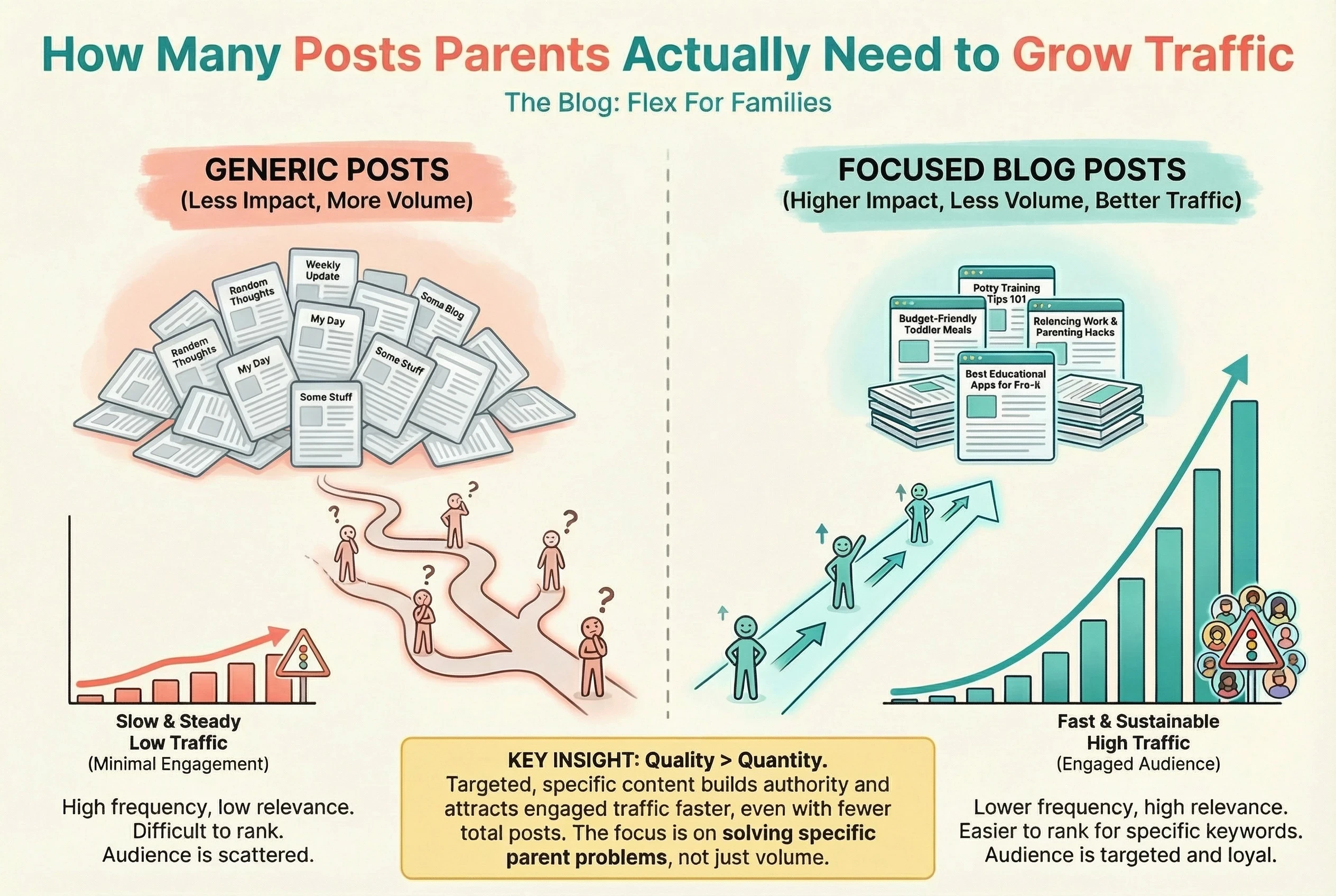
In reality, traffic growth has much more to do with quality and intent than volume.
You do not need 100 posts to see movement
Many parent blogs start seeing impressions and early clicks with far fewer posts. What matters is whether those posts answer specific questions people are already searching for.
Ten focused posts can outperform fifty generic ones.
A realistic target for busy parents
For most parents, a realistic and sustainable target looks like this:
- 1 post per week, or
- 2 posts every other week
Over three months, that is:
- 6 to 12 solid posts
Over six months, that becomes:
- 12 to 24 posts
At that point, many parents start to see:
- Impressions in Google Search Console
- Posts ranking on page two or three
- Occasional clicks without promotion
Those are signs the system is working, even if traffic is still small.
What matters more than post count
Parents grow traffic faster when they:
- Answer narrow, specific questions
- Write with one clear reader problem in mind
- Internally link related posts
- Improve existing content instead of starting over
Traffic growth usually feels slow right up until it starts to feel obvious.
The parents who see results are not the ones publishing the most. They are the ones who keep publishing the right kind of content without restarting every month.
What To Stop Doing If Time is Limited
When time is tight, progress usually stalls because parents are doing too many things that do not move traffic.
Growing traffic with limited time often means stopping certain habits, even if they feel productive.
Stop chasing every traffic strategy
Pinterest, SEO, Instagram, Facebook, email, and YouTube. Trying to do all of them at once spreads effort thin. Pick one primary traffic source and commit to it long enough to see results.
For most parents, that primary focus should be SEO.
Stop posting daily on social platforms
Daily posting sounds impressive, but it rarely compounds for busy parents. Social content disappears fast. Miss a few days and momentum resets.
Time spent on social often delivers less long-term value than one solid blog post.
Stop restarting your blog every few months
Changing niches, redesigning themes, and rewriting goals feels like progress. It is usually avoidance.
Traffic grows from continuing, not restarting.
Stop over-optimising too early
Obsessing over page speed, plugins, and perfect formatting before traffic exists wastes energy. Early blogs need content, not perfection.
Stop comparing your timeline to others
Many bloggers you see online work full-time. Comparing your progress to theirs makes normal growth feel like failure.
Traffic growth for parents is slower by design. That does not mean it is broken.
When time is limited, the goal is not to do more. It is to remove what distracts you from compounding work.
A Simple Traffic Plan Parents Can Follow
When time is limited, a simple plan beats a perfect one.
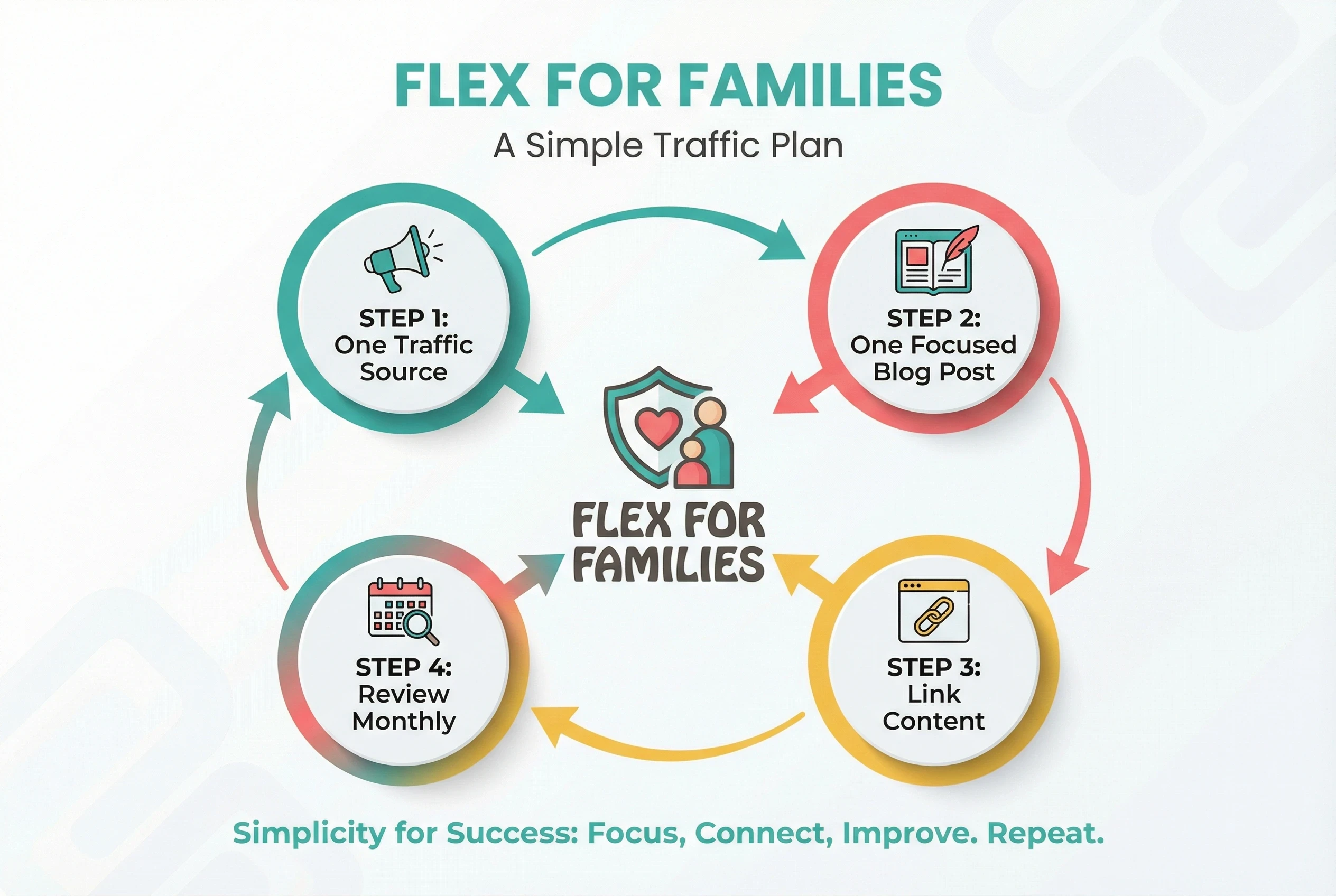
This is a traffic plan parents can follow without burning out or constantly restarting.
Pick one primary traffic source
Choose one way people will find your blog and commit to it for the next 60 to 90 days.
For most parents, that source should be SEO. It compounds and does not require daily activity.
Ignore everything else for now. You can add channels later.
Create one focused post at a time
Each post should answer one clear question or solve one specific problem.
Do not aim for long or complex. Aim for helpful and clear.
If you can publish:
- One post every week, or
- Two posts every other week
You are doing enough.
Use short sessions on purpose
Break the work into small pieces:
- Research in one session
- Draft in another
- Edit later
Progress adds up when you stop waiting for perfect conditions.
Link your content together
Each new post should link to at least one older post, and vice versa when relevant. This helps search engines understand your site and helps readers stay longer.
Internal linking is one of the highest return tasks parents can do.
Review progress every 30 days
Once a month, check:
- Which posts are getting impressions
- Which posts are ranking anywhere at all
- What topics seem to attract interest
Then adjust slightly. Do not restart.
Want help creating a blogging plan? Check out our guide called How To Plan Your Next 30 Days of Blog Growth and get started on the right path
Learn SEO the calm way
Parents who succeed usually learn SEO step by step, alongside monetisation, instead of trying to master everything at once.
This is why many parents use Wealthy Affiliate. It teaches SEO, content creation, and monetisation together, in a way that fits short, realistic work sessions.
The goal is not fast traffic.
The goal is steady traffic that grows while life happens.
How Long Does Traffic Realistically Take to Grow
One of the biggest reasons parents quit blogging is unrealistic timelines.
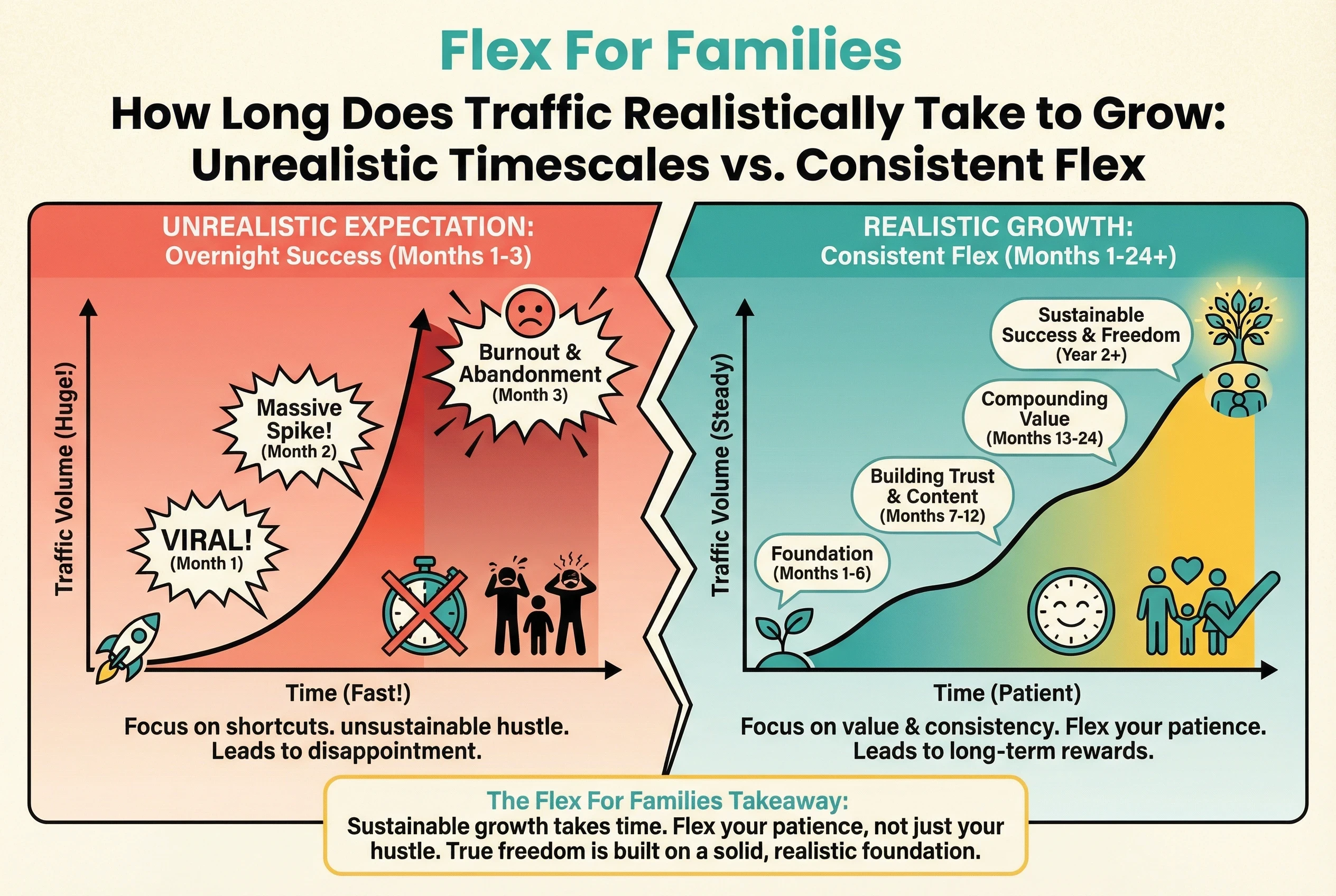
Traffic does not usually grow in a straight line, especially when you are working limited hours.
The first 1 to 3 months
This phase often feels quiet.
You may see:
- Very little traffic
- A few impressions in Google Search Console
- No clear signs that posts are “working”
This is normal. Search engines are learning what your site is about.
The first 3 to 6 months
This is when early signals usually appear.
You may notice:
- More impressions
- Posts ranking on page two or three
- Occasional clicks without promotion
This is progress, even if traffic numbers are still small.
The first 6 to 12 months
This is when traffic often starts to feel real.
You may see:
- A handful of posts bringing consistent visits
- Traffic growing without daily effort
- Clear topics that perform better than others
At this stage, many parents realise the work they did months ago is finally paying off.
Why patience matters more than intensity
Parents who push hard for a few weeks and then stop rarely see results. Parents who work steadily, even slowly, almost always do.
Traffic growth rewards continuity, not bursts of effort.
For parents, this is good news. You do not need long hours. You need to keep showing up without restarting.
FAQ. Growing Blog Traffic with Limited Time as a Parent
How can parents grow blog traffic with limited time?
Parents grow blog traffic by focusing on one main strategy, usually SEO, and creating helpful content consistently in short sessions. Fewer high-intent posts outperform frequent unfocused activity.
Is SEO really better than social media for busy parents?
For most busy parents, yes. SEO content keeps working even when you step away, while social media traffic usually drops when posting stops. That makes SEO more forgiving around family life.
How many blog posts do parents need before traffic grows?
Many parents start seeing impressions and early clicks with 12 to 24 focused posts. Quality, intent, and internal linking matter more than publishing large volumes of content.
How long does it take parents to see blog traffic?
Most parents see early signals within 3 to 6 months and more noticeable traffic between 6 and 12 months. Progress often shows in impressions before clicks.
Do parents need to post every week to grow traffic?
Weekly posting helps, but it is not required. Parents can still grow traffic by posting consistently at a pace they can maintain, such as one post every two weeks.
What is the easiest traffic strategy for parent bloggers?
SEO is often the easiest long-term traffic strategy for parents because it compounds over time and does not require daily activity. Many parents learn SEO step by step through platforms like Wealthy Affiliate.
Final Mindset Shift for Parents
Growing blog traffic as a parent is not about doing more. It is about doing fewer things long enough for them to work.
Traffic grows from assets, not activity. Posts that answer real questions keep working after you log off. That is what makes progress possible around family life.
Missed weeks do not ruin progress. Restarting strategies does.
If you focus on one traffic path, create helpful content, and keep going even when results feel slow, traffic will grow. Not overnight. But steadily. And in a way that fits real life.
If you want a calm, step-by-step way to learn SEO and monetisation without pressure, Wealthy Affiliate is where many parents start.
It teaches SEO, content creation, and monetisation together. Hosting and tools are included. You can make progress in short sessions and pick up where you left off.
Let’s Chat
What traffic strategy are you focusing on right now?
What feels harder at the moment, patience or consistency?
Share your situation in the comments. I read every reply and I am happy to help you choose a path that fits your life.




Hey John, this is some good advice you’ve given here. I was especially surprised to see your point about stopping and restarting again. Its so important to keep going and building on previous progress even if there are breaks inbetween. I’ve experienced this myself. Building on previous progress definitely helped the results to show up faster. Its important to be consistent even when times get busy. Thanks for sharing!
Hey, I’m really glad that part stood out to you.
Stopping and restarting is something most parent bloggers go through, even if we don’t always admit it. Life shifts. Kids get sick. Work ramps up. Energy dips. The key isn’t never stopping, it’s knowing you can restart without feeling like you’re back at zero.
What you said is spot on. When you come back and build on what’s already there, you’re not starting over. You’re stacking effort on top of previous progress. Updating posts, improving headlines, adding internal links, sharing an old post again, all of that compounds faster than starting from scratch every time.
Consistency doesn’t always look like daily publishing. Sometimes it’s simply staying connected to your blog, even in small ways, during busy seasons.
Thanks for sharing your experience. It’s encouraging for other parents to hear that breaks don’t erase momentum.
John
I love this topic because it really highlights how parenting changes the way we approach blogging. Most guides assume we have hours to work every day, but for parents, even 30–60 minutes can be all we get at a time.
The key takeaway is that focus beats volume. One well-researched, high-intent post can outperform ten generic posts, especially if you use internal linking and improve older content.
I’m curious: for parents who have been blogging for a few months, what strategy have you found easiest to stick with consistently, SEO, Pinterest, or social media? Do you feel patience or consistency is harder to maintain?
Also, I’d love to hear if anyone has noticed the compounding effect of SEO over time. For example, did you publish a few posts that didn’t get clicks at first, then later started bringing steady traffic?
This kind of discussion really helps parents see that growth is possible even with limited time, and it gives real strategies that fit around family life.
Hey Monica,
I love how you’ve framed that, focus really does beat volume for parents.
When time is tight, one strong, search-focused post that solves a clear problem will usually do more than a batch of rushed content. Especially if you go back and improve older posts instead of always chasing new ones.
To your question, for most parents I’ve worked with, SEO is the easiest strategy to stick with long term. Why? Because it compounds quietly in the background. You write once, optimise properly, and that post can keep working for months or years. Pinterest and social media can work well, but they often need more ongoing input to keep traffic flowing.
And yes, the compounding effect of SEO is very real. I’ve had posts sit quietly for 2–3 months with barely any clicks, then slowly start climbing. Sometimes it’s a small tweak, better internal linking, clearer intent, or just time in Google’s index. Then suddenly they bring steady traffic without any extra effort.
On the patience versus consistency question, I’d say patience is harder. Most parents are already consistent in other areas of life. What’s tough is doing the work when the results are invisible. That gap between effort and feedback is where most people wobble.
Really appreciate you opening up that discussion. It’s exactly the kind of realistic conversation that helps parents see growth is possible, even in small pockets of time.
John